
RFID Labels
What Are RFID Labels?
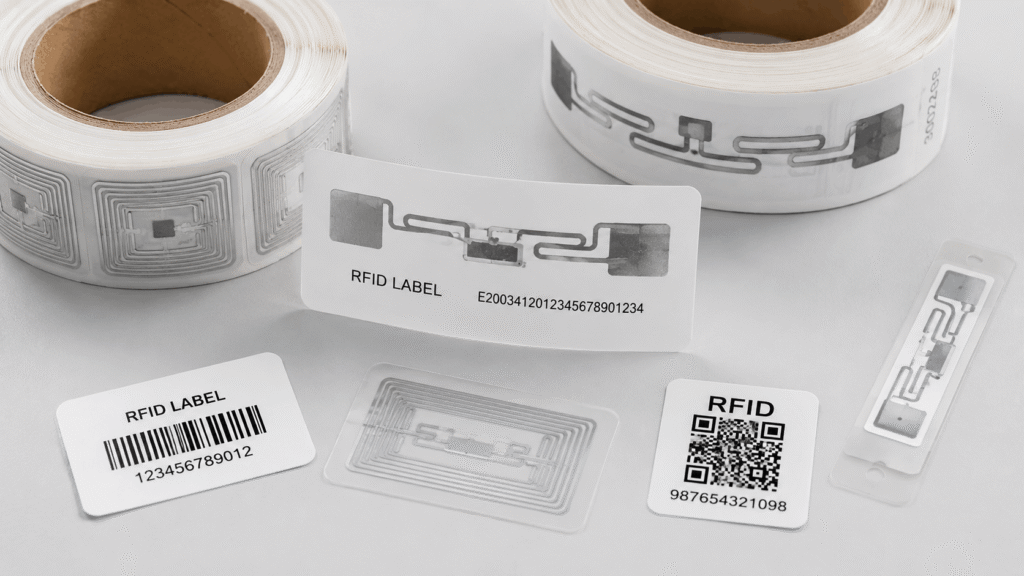
RFID Labels (Radio Frequency Identification Labels) are intelligent labels embedded with a microchip and antenna that communicate wirelessly with RFID readers using radio frequency signals. Unlike traditional barcode labels that require direct line-of-sight scanning, RFID labels can be read automatically from a distance, allowing businesses to identify, track, and manage products, assets, and inventory with greater speed and accuracy.
RFID labels have become an essential component of modern inventory management, warehouse automation, retail operations, logistics, manufacturing, healthcare, and asset tracking systems. Each RFID label contains a unique digital identity that stores important information such as product details, serial numbers, EPC codes, batch numbers, manufacturing dates, and location data.
When an RFID reader emits radio waves, the RFID label instantly responds by transmitting the stored information. This enables businesses to automate data collection, reduce manual errors, improve inventory visibility, and achieve real-time tracking without physical contact or manual scanning.
At RFGenie, we manufacture high-performance RFID labels designed for demanding industrial environments. Our RFID labels are engineered to deliver high read accuracy, excellent durability, and seamless compatibility with leading RFID readers and enterprise systems. Whether you require RFID labels for retail, logistics, healthcare, manufacturing, apparel, warehousing, or asset management, RFGenie provides reliable RFID solutions tailored to your operational requirements.
How Do RFID Labels Work?
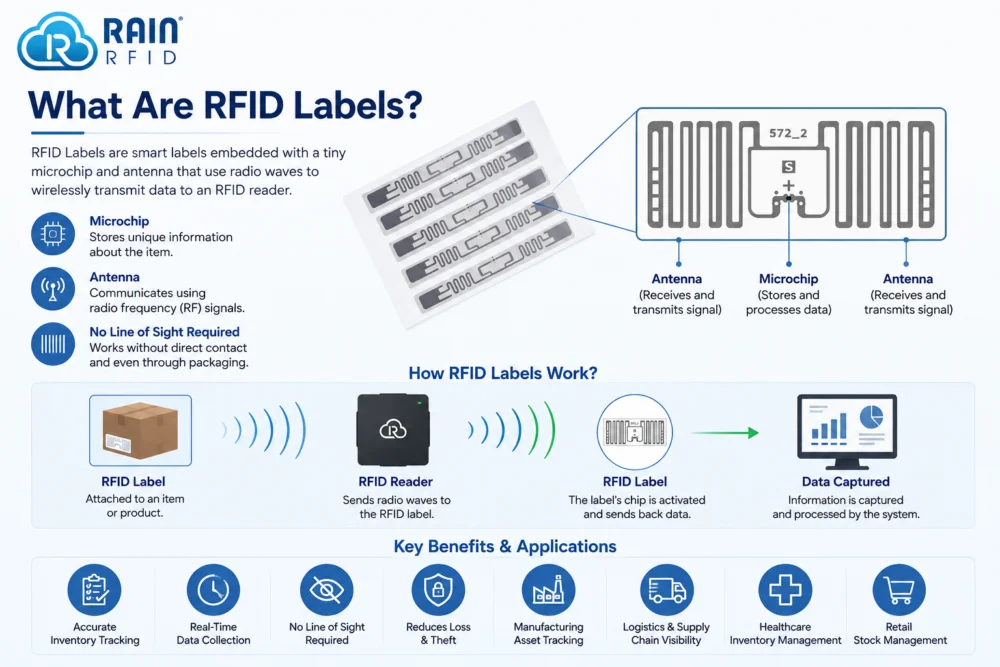
RFID labels work by using radio frequency technology to exchange data between an RFID label and an RFID reader. Each RFID label contains two essential components: a microchip that stores digital information and an antenna that receives and transmits radio signals. Unlike barcode labels, RFID labels do not require direct line-of-sight scanning, making the identification process much faster and more efficient.
When an RFID reader emits radio waves, the antenna inside the RFID label captures the signal and activates the embedded microchip. The chip then transmits its stored information back to the reader through the antenna. This information may include the Electronic Product Code (EPC), serial number, product details, manufacturing information, batch number, or any other encoded business data.
The RFID reader instantly receives the transmitted data and sends it to the connected software or enterprise management system. The software processes the information in real time, allowing businesses to automatically update inventory records, monitor asset locations, track product movement, and improve overall operational efficiency.
Because RFID technology enables multiple labels to be read simultaneously from several metres away, it significantly reduces manual scanning time and minimizes human errors. This makes RFID labels an ideal solution for inventory management, warehouse automation, retail operations, manufacturing, logistics, healthcare, asset tracking, and supply chain management.
Components of RFID Labels
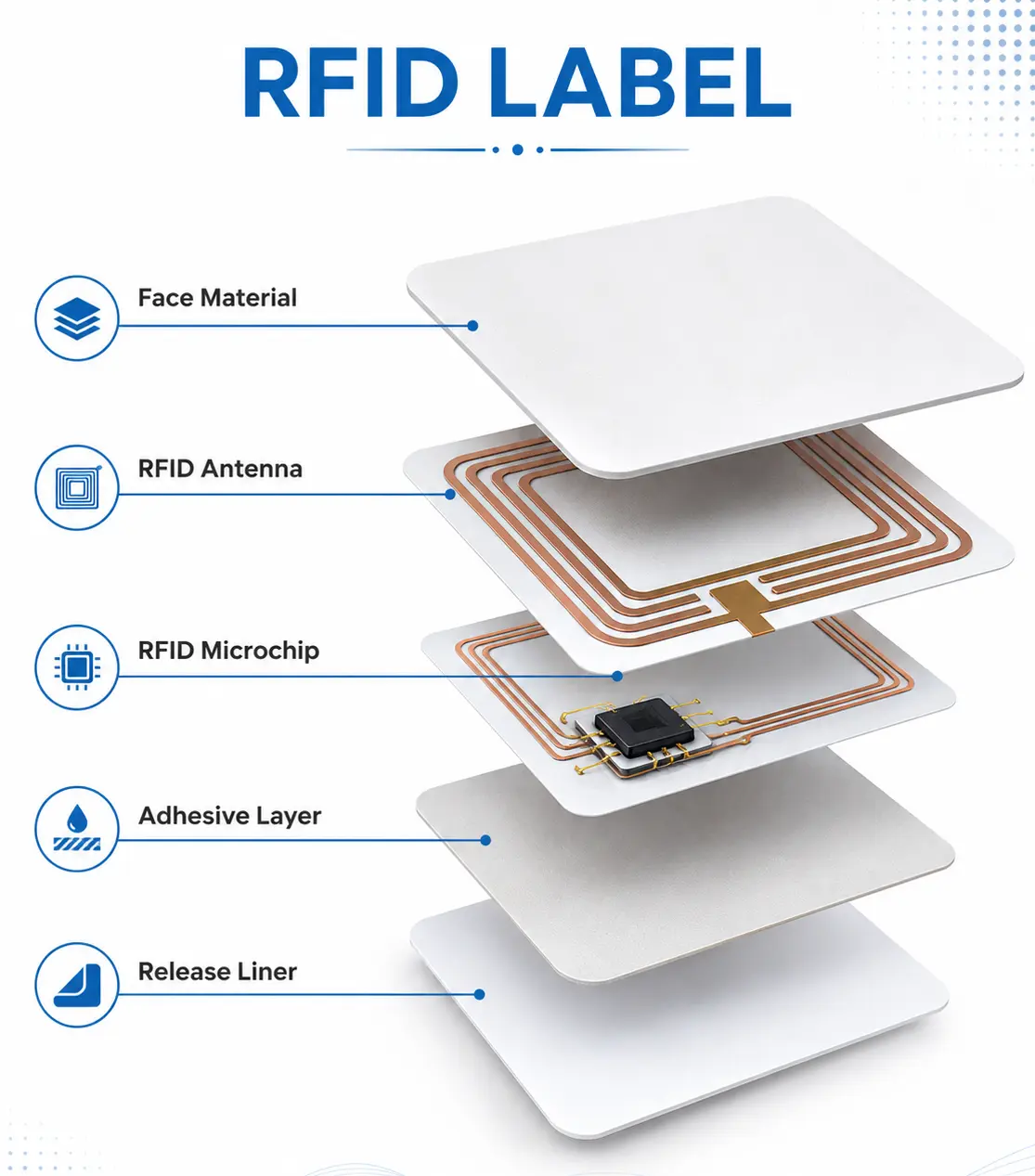
Every RFID label consists of multiple layers that work together to enable wireless identification, data storage, and asset tracking. Understanding these components helps businesses choose the right RFID label for retail, logistics, healthcare, manufacturing, and asset management applications.
1. Face Material (Label Surface)
The face material is the printable outer layer of the RFID label. It can be manufactured using paper, polyester (PET), polypropylene (PP), or other synthetic materials depending on the operating environment. This layer allows businesses to print barcodes, QR codes, product names, logos, serial numbers, and variable information alongside RFID technology.
2. RFID Antenna
The antenna enables communication between the RFID label and the RFID reader. It receives radio frequency signals from the reader, powers the chip in passive RFID labels, and transmits the stored information back to the reader. The antenna design directly influences the read range, reading speed, and overall performance of the RFID label.
3. RFID Microchip (Integrated Circuit)
The microchip is the brain of an RFID label. It stores and processes digital information such as the Electronic Product Code (EPC), serial number, product identification, batch number, manufacturing details, and user-defined data. Depending on the application, RFID chips can be read-only, write-once, or read-and-write, allowing businesses to update information whenever required.
4. Adhesive Layer
The adhesive securely attaches the RFID label to products, cartons, pallets, equipment, or assets. Different adhesive options are available for cardboard, plastic, metal, glass, wood, and other surfaces to ensure long-lasting performance under various environmental conditions.
5. Protective Layer
Many industrial RFID labels include an additional protective layer that shields the embedded chip and antenna from dust, moisture, chemicals, abrasion, UV exposure, and harsh environmental conditions. This improves durability and ensures consistent performance throughout the label’s lifecycle.
At RFGenie, our RFID labels are engineered using premium-quality materials, high-performance RFID chips, and precision antenna designs to deliver exceptional read accuracy, durability, and reliable performance for retail, manufacturing, logistics, healthcare, warehouse automation, and industrial asset tracking applications.
Types of RFID Labels
RFID labels are available in various types, each designed to meet specific business requirements, operating environments, and tracking applications.
The right RFID label depends on factors such as operating frequency, read range, surface material, environmental conditions, memory capacity, and the type of assets being tracked. Choosing the correct RFID label improves inventory visibility, enhances asset tracking, reduces manual errors, and increases operational efficiency.
Whether your business operates in retail, logistics, manufacturing, healthcare, warehouse automation, or supply chain management, understanding the different types of RFID labels helps you select the most suitable solution for long-term performance.
1. Passive RFID Labels
Passive RFID labels are the most widely used type of RFID labels across industries because they are affordable, lightweight, and highly reliable. Unlike active RFID labels, passive RFID labels do not contain an internal battery. They are powered by the electromagnetic signal transmitted from an RFID reader. When the reader emits radio waves, the antenna inside the label captures the energy, activates the embedded RFID chip, and sends the stored data back to the reader.
Because they require no battery, passive RFID labels have a long operational life and minimal maintenance requirements. They are ideal for high-volume deployments where thousands or even millions of labels are used.
Common Applications
- Inventory Management
- Warehouse Automation
- Retail Product Tracking
- Library Management
- Document Tracking
- Healthcare Equipment Tracking
- Asset Management
Advantages
- No battery required
- Long service life
- Cost-effective for bulk deployment
- High reading accuracy
- Low maintenance
- Easy integration with existing RFID systems
2. Active RFID Labels
Active RFID labels are equipped with an internal battery that continuously powers the RFID chip, allowing the label to broadcast signals over much greater distances than passive RFID labels. These labels are designed for tracking high-value assets and applications requiring real-time location monitoring.
Due to their extended read range and continuous communication capability, active RFID labels are commonly used in industrial environments, transportation systems, mining operations, construction sites, airports, ports, and large manufacturing facilities.
Although they have a higher initial cost, active RFID labels provide superior performance for mission-critical tracking applications where visibility and accuracy are essential.
Common Applications
- Vehicle Tracking
- Shipping Containers
- Heavy Equipment
- Mining Assets
- Construction Machinery
- Airport Asset Management
- Industrial Equipment Monitoring
Advantages
- Extended read range
- Real-time tracking
- Fast communication
- Suitable for outdoor environments
- Excellent performance over large areas
3. Battery-Assisted Passive (BAP) RFID Labels
Battery-Assisted Passive RFID labels, also known as Semi-Passive RFID labels, combine the strengths of passive and active RFID technology. The built-in battery powers the microchip, while communication with the RFID reader still relies on backscatter technology. This design improves sensitivity and enables reliable reading in challenging environments.
BAP RFID labels are particularly useful for cold storage facilities, pharmaceutical logistics, industrial monitoring, and environmental sensing applications where consistent performance is required.
Common Applications
- Cold Chain Logistics
- Pharmaceutical Storage
- Food Distribution
- Environmental Monitoring
- Industrial Automation
Advantages
- Better sensitivity
- Improved reading reliability
- Longer communication distance than passive RFID
- Ideal for difficult environments
4. UHF RFID Labels
Ultra High Frequency (UHF) RFID labels are the industry standard for large-scale inventory management and supply chain automation. Operating within the 860–960 MHz frequency range, UHF RFID labels offer fast reading speeds, long read distances, and the ability to identify multiple items simultaneously without requiring direct line of sight.
Businesses use UHF RFID labels to automate warehouse operations, monitor inventory movement, optimise logistics, and improve order accuracy. Their ability to process hundreds of tags within seconds significantly reduces manual labour and operational costs.
Industries Using UHF RFID Labels
- Retail
- Warehousing
- Distribution Centres
- Manufacturing
- Logistics
- Apparel
- E-commerce Fulfilment
- Automotive
Advantages
- Long read distance
- High-speed scanning
- Bulk tag reading
- Excellent inventory visibility
- Increased warehouse productivity
5. HF RFID Labels
High Frequency (HF) RFID labels operate at 13.56 MHz and are designed for applications requiring secure communication and short-range identification. Their stable performance around liquids and non-metallic materials makes them ideal for environments where accuracy is more important than long reading distance.
HF RFID labels are frequently used in hospitals, libraries, universities, smart ticketing systems, access control, and secure authentication solutions.
Common Applications
- Healthcare
- Patient Identification
- Library Systems
- Access Control
- Ticketing
- Smart Cards
- Document Tracking
Advantages
- Secure communication
- Excellent reading accuracy
- Reliable performance
- Ideal for authentication systems
6. NFC RFID Labels
Near Field Communication (NFC) labels are a specialised type of HF RFID label that can communicate directly with smartphones, tablets, and other NFC-enabled devices. Unlike conventional RFID labels, NFC labels are widely used for customer engagement, product authentication, marketing campaigns, and digital information sharing.
Businesses can programme NFC labels to open websites, launch mobile applications, display product manuals, verify product authenticity, or provide instant customer support with a simple tap.
Common Applications
- Smart Packaging
- Product Authentication
- Marketing Campaigns
- Digital Business Cards
- Event Management
- Customer Engagement
- Interactive Product Information
Advantages
- Smartphone compatible
- Contactless information sharing
- Easy programming
- Secure authentication
- Enhanced customer experience
7. Printable RFID Labels
Printable RFID labels combine traditional printed information with advanced RFID technology. These labels allow businesses to print barcodes, QR codes, serial numbers, logos, product descriptions, batch numbers, and variable information while simultaneously storing digital information inside the RFID chip.
This dual-identification capability simplifies inventory management and improves operational efficiency by allowing both barcode scanners and RFID readers to identify products.
Common Applications
- Product Labelling
- Retail Inventory
- Logistics
- Manufacturing
- Pharmaceutical Packaging
- Warehouse Operations
Advantages
- Barcode and RFID in one label
- Custom printing
- Variable data support
- Faster product identification
- Reduced labelling costs
8. On-Metal RFID Labels
Standard RFID labels often experience signal interference when applied directly to metallic surfaces. On-Metal RFID labels are specifically engineered with specialised shielding materials that eliminate interference and ensure consistent communication on metal objects.
These labels are designed for demanding industrial environments where assets such as machinery, metal containers, tools, pipes, and equipment require accurate identification.
Common Applications
- Industrial Equipment
- Metal Containers
- Manufacturing Plants
- Oil & Gas Industry
- Construction Equipment
- Tool Tracking
- Aerospace Components
Advantages
- Reliable performance on metal surfaces
- Durable industrial construction
- Resistant to harsh environments
- Long operational life
- Accurate asset identification
8. On-Metal RFID Labels
Standard RFID labels often experience signal interference when applied directly to metallic surfaces. On-Metal RFID labels are specifically engineered with specialised shielding materials that eliminate interference and ensure consistent communication on metal objects.
These labels are designed for demanding industrial environments where assets such as machinery, metal containers, tools, pipes, and equipment require accurate identification.
Common Applications
- Industrial Equipment
- Metal Containers
- Manufacturing Plants
- Oil & Gas Industry
- Construction Equipment
- Tool Tracking
- Aerospace Components
Advantages
- Reliable performance on metal surfaces
- Durable industrial construction
- Resistant to harsh environments
- Long operational life
- Accurate asset identification
Applications of RFID Labels
RFID labels are transforming the way businesses manage inventory, assets, products, and supply chains. By enabling automatic identification and real-time data capture, RFID labels help organisations improve operational efficiency, reduce manual errors, and gain complete visibility over their assets. From retail stores to manufacturing plants, RFID labels are widely adopted across industries to streamline processes, enhance security, and optimise resource management.
Below are some of the most common applications of RFID labels across different industries.
RFID Labels for Retail Inventory Management
Retail businesses use RFID labels to automate inventory tracking, improve stock accuracy, and enhance the overall customer shopping experience. Unlike traditional barcode systems that require line-of-sight scanning, RFID labels allow multiple products to be scanned simultaneously, significantly reducing inventory counting time.
Retailers can monitor stock movement in real time, quickly identify out-of-stock items, reduce inventory shrinkage, and improve product availability. RFID labels also help streamline checkout operations, warehouse replenishment, and omnichannel order fulfilment.
- Faster inventory counting
- Improved stock accuracy
- Reduced product loss
- Better customer experience
- Real-time inventory visibility
RFID Labels for Warehouse Management
Warehouse operations involve handling thousands of products daily, making speed and accuracy essential. RFID labels automate product identification, inventory movement, receiving, picking, packing, and dispatch operations.
Warehouse managers can instantly locate products, monitor inventory levels, reduce manual labour, and minimise picking errors. RFID labels improve warehouse productivity while enabling accurate stock management and faster order processing.
Benefits:
- Automated inventory management
- Faster product tracking
- Reduced manual scanning
- Improved warehouse efficiency
- Accurate order fulfilment
RFID Labels for Logistics & Supply Chain
RFID labels provide complete visibility throughout the supply chain by enabling businesses to track shipments, pallets, cartons, and containers from origin to destination. Real-time tracking improves shipment accuracy, reduces transit delays, and enhances operational transparency.
Logistics companies use RFID labels to monitor goods movement, optimise transportation, prevent shipment loss, and improve customer satisfaction through accurate delivery tracking.
Benefits:
- Real-time shipment tracking
- Reduced delivery errors
- Improved supply chain visibility
- Faster logistics operations
- Better inventory control
RFID Labels for Manufacturing
Manufacturing industries rely on RFID labels to track raw materials, work-in-progress components, finished goods, and production equipment. RFID technology improves production visibility, automates material handling, and ensures accurate inventory records.
Manufacturers also use RFID labels for quality control, product traceability, equipment maintenance, and lean manufacturing initiatives, helping reduce downtime and increase operational efficiency.
Benefits:
- Production tracking
- Material traceability
- Improved quality control
- Reduced manufacturing errors
- Enhanced operational efficiency
RFID Labels for Healthcare
Hospitals and healthcare facilities use RFID labels to track medical equipment, patient records, laboratory samples, surgical instruments, and pharmaceutical inventory. RFID technology helps improve patient safety while reducing equipment loss and manual documentation.
Healthcare organisations can accurately locate critical medical devices, monitor medicine inventory, and maintain compliance with healthcare regulations through automated identification systems.
Benefits:
- Medical equipment tracking
- Patient safety
- Pharmaceutical inventory control
- Reduced equipment loss
- Improved operational efficiency
RFID Labels for Asset Tracking
Businesses across multiple industries use RFID labels to manage valuable assets such as laptops, tools, machinery, office equipment, laboratory instruments, and IT infrastructure. RFID labels simplify asset audits, reduce manual record keeping, and provide complete visibility of asset movement.
With automated asset tracking, organisations can minimise losses, improve accountability, and optimise equipment utilisation.
Benefits:
- Real-time asset visibility
- Faster audits
- Reduced asset loss
- Improved utilisation
- Simplified maintenance tracking
RFID Labels for Apparel & Fashion Industry
The apparel industry uses RFID labels to improve inventory accuracy, reduce stock discrepancies, and enhance the customer shopping experience. Fashion retailers can quickly locate garments, automate stock replenishment, and manage seasonal inventory more efficiently.
RFID labels also help reduce theft, simplify returns management, and improve omnichannel retail operations.
Benefits:
- Faster stock management
- Better inventory accuracy
- Improved customer experience
- Efficient product replenishment
- Theft reduction
RFID Labels for Jewellery Tracking
Jewellery retailers require highly accurate tracking systems for valuable products. RFID labels provide secure identification of rings, necklaces, bracelets, earrings, and other high-value items while reducing manual inventory efforts.
Jewellery businesses can perform complete inventory verification within minutes, minimise product loss, and improve customer service through instant product identification.
Benefits:
- High-value asset security
- Faster inventory audits
- Accurate stock management
- Reduced inventory shrinkage
- Improved customer service
RFID Labels for Library Management
Libraries use RFID labels to automate book issuing, returns, inventory verification, and shelf management. RFID technology enables librarians to quickly identify misplaced books, reduce manual work, and improve the overall borrowing experience.
RFID labels also enhance security by preventing unauthorised removal of library materials.
Benefits:
- Automated book management
- Faster issue and return process
- Improved inventory accuracy
- Reduced manual effort
- Enhanced library security
RFID Labels for Cold Chain & Pharmaceutical Logistics
Cold chain logistics require continuous monitoring and accurate identification of temperature-sensitive products such as vaccines, medicines, and food items. RFID labels help organisations maintain product traceability, reduce spoilage, and comply with regulatory requirements.
By integrating RFID technology with warehouse and transportation systems, businesses gain complete visibility throughout the cold chain process.
Benefits:
- Product traceability
- Regulatory compliance
- Reduced product spoilage
- Accurate inventory management
- Improved logistics efficiency
Benefits of RFID Labels
RFID labels have become an essential technology for businesses looking to improve inventory management, asset tracking, warehouse operations, and supply chain visibility. Unlike traditional barcode systems, RFID labels use radio frequency technology to identify and track multiple items simultaneously without requiring a direct line of sight. This enables organisations to automate business processes, reduce operational costs, and improve overall efficiency.
Whether you operate in retail, logistics, healthcare, manufacturing, or asset management, RFID labels provide significant advantages that enhance productivity and support data-driven decision-making.
1. Faster Inventory Management
One of the biggest advantages of RFID labels is the ability to perform inventory counts much faster than traditional barcode systems. Hundreds of RFID-tagged items can be scanned simultaneously, eliminating the need to scan each product individually.
This allows businesses to conduct inventory audits in a fraction of the time, maintain accurate stock records, and reduce disruptions to daily operations.
key Benefits:
- Rapid inventory counting
- Reduced manual effort
- Improved stock accuracy
- Faster warehouse operations
2. Improved Inventory Accuracy
Manual inventory processes often lead to counting errors, misplaced products, and inaccurate stock records. RFID labels automatically capture data with high precision, ensuring that inventory information remains accurate and up to date.
Accurate inventory helps businesses prevent stock shortages, reduce overstocking, and improve purchasing decisions.
key Benefits:
- Accurate stock visibility
- Fewer inventory discrepancies
- Better demand planning
- Improved order accuracy
3. Real-Time Asset Tracking
RFID labels enable businesses to monitor the movement and location of assets in real time. Whether tracking equipment, tools, pallets, medical devices, or high-value products, organisations gain complete visibility throughout the asset lifecycle.
Real-time tracking helps reduce losses, improve accountability, and optimise asset utilisation.
key Benefits:
- Instant asset visibility
- Reduced asset loss
- Better utilisation
- Simplified asset audits
4. No Line-of-Sight Scanning Required
Unlike barcodes, RFID labels do not require direct visual alignment with the scanner. RFID readers can identify labels through packaging, cartons, and containers, making data capture significantly faster and more convenient.
This feature improves productivity in warehouses, manufacturing facilities, and distribution centres where large volumes of products are handled daily.
key Benefits:
- Faster scanning
- Reduced handling time
- Increased operational efficiency
- Improved workflow automation
5. Simultaneous Reading of Multiple Items
RFID technology allows multiple labels to be read at the same time. Instead of scanning products one by one, businesses can identify entire cartons, pallets, or shelves within seconds.
This capability dramatically increases productivity and reduces labour requirements.
key Benefits:
- Bulk scanning capability
- Faster receiving and dispatch
- Reduced labour costs
- Higher operational efficiency
6. Enhanced Supply Chain Visibility
RFID labels provide complete visibility across the supply chain by tracking products from manufacturing to final delivery. Businesses can monitor shipment status, inventory movement, and warehouse operations in real time.
Improved visibility enables faster decision-making, better customer service, and more efficient logistics management.
key Benefits:
- End-to-end product tracking
- Improved logistics planning
- Reduced shipment delays
- Greater supply chain transparency
7. Reduced Human Errors
Manual data entry and barcode scanning increase the risk of mistakes. RFID labels automate the identification process, significantly reducing errors in inventory management, order fulfilment, and asset tracking.
This leads to more reliable business data and smoother day-to-day operations.
key Benefits:
- Accurate data collection
- Reduced manual mistakes
- Better operational control
- Improved productivity
8. Better Security and Loss Prevention
RFID labels help businesses monitor valuable assets and inventory more effectively. Unauthorised movement of products can be detected instantly, reducing theft, loss, and inventory shrinkage.
Retail stores, warehouses, hospitals, and manufacturing facilities widely use RFID technology to improve asset security.
key Benefits:
- Reduced theft
- Better inventory control
- Improved asset security
- Enhanced traceability
9. Lower Operational Costs
Although RFID implementation requires an initial investment, businesses often achieve substantial long-term savings through automation, improved inventory accuracy, reduced labour, and fewer operational errors.
These improvements contribute to a stronger return on investment over time.
key Benefits:
- Reduced labour expenses
- Lower inventory losses
- Improved operational efficiency
- Higher return on investment
10. Scalable for Business Growth
RFID labels can easily scale as business operations expand. Whether tracking hundreds or millions of products, RFID systems can support increasing inventory volumes without compromising performance.
This makes RFID labels a future-ready solution for businesses planning long-term growth.
key Benefits:
- Easy scalability
- Supports business expansion
- Flexible deployment
- Long-term operational value
RFID Labels vs Barcode Labels
Both RFID labels and barcode labels are widely used for product identification and inventory management. However, they differ significantly in terms of technology, speed, accuracy, and overall efficiency. While barcode labels have been used for decades, RFID labels offer a smarter and more automated solution for modern businesses that require real-time visibility, faster inventory management, and improved operational accuracy.
Choosing between RFID labels and barcode labels depends on your business requirements, inventory size, operational workflow, and long-term automation goals. Understanding the key differences can help businesses make the right investment for improved productivity and growth.
Comparison Between RFID Labels and Barcode Labels
| Feature | RFID Labels | Barcode Labels |
|---|---|---|
| Technology | Uses Radio Frequency Identification (RFID) technology | Uses printed optical barcode |
| Line of Sight | Not Required | Required |
| Reading Speed | Can scan hundreds of labels simultaneously | One label at a time |
| Read Range | From a few centimetres up to several metres depending on the RFID type | Usually a few centimetres |
| Data Storage | Stores more digital information | Limited information |
| Rewritable | Yes, many RFID labels can be updated | No |
| Durability | Resistant to dirt, moisture, and harsh environments | Easily damaged by scratches or dirt |
| Automation | Supports fully automated tracking | Mostly manual scanning |
| Inventory Accuracy | Very High | Moderate |
| Labour Requirement | Low | High |
| Asset Tracking | Real-time tracking possible | Not suitable for real-time tracking |
| Security | Better security with unique identifiers | Easier to duplicate |
Read Range
One of the biggest advantages of RFID labels is their ability to be read from a distance without requiring direct visual contact. Depending on the RFID technology being used, labels can be scanned from several centimetres to several metres away. Barcode labels, on the other hand, require the scanner to be positioned directly in front of each label, making the scanning process slower and more labour-intensive.
Speed and Efficiency
RFID labels significantly improve operational efficiency because multiple labels can be read simultaneously. Entire cartons, pallets, or shelves can be scanned within seconds, reducing inventory counting time and improving warehouse productivity.
Barcode labels require each product to be scanned individually, which increases manual effort and slows down inventory operations, particularly in high-volume environments.
Inventory Accuracy
RFID technology provides highly accurate inventory data through automated identification and real-time tracking. Businesses can monitor stock movement continuously, reducing inventory discrepancies and improving order accuracy.
Barcode systems depend heavily on manual scanning, making them more susceptible to human errors, missed scans, and inaccurate inventory records.
Data Storage Capacity
RFID labels contain an embedded microchip capable of storing significantly more information than traditional barcode labels. Product details, serial numbers, manufacturing information, maintenance history, batch numbers, and other critical data can be stored and updated when required.
Barcode labels generally contain only a limited amount of printed information that cannot be modified after printing.
Durability and Reliability
RFID labels are designed to perform reliably in demanding industrial environments. Many RFID labels are resistant to dust, moisture, heat, chemicals, and physical wear, making them suitable for manufacturing, logistics, healthcare, and outdoor applications.
Barcode labels can become unreadable if they are scratched, torn, dirty, or exposed to harsh environmental conditions.
Cost Considerations
Barcode labels are generally less expensive to purchase and implement, making them suitable for small businesses with basic tracking requirements.
RFID labels involve a higher initial investment due to RFID readers, tags, and software. However, businesses often recover these costs through improved operational efficiency, reduced labour, fewer inventory errors, and better asset utilisation. For medium and large organisations, RFID technology typically provides greater long-term value.
Which Solution is Right for Your Business?
The choice between RFID labels and barcode labels depends on your operational requirements.
Barcode labels are suitable for businesses with limited inventory, simple tracking needs, and lower automation requirements.
RFID labels are ideal for organisations that require real-time inventory visibility, automated warehouse management, faster stock counting, asset tracking, supply chain optimisation, and scalable business operations.
Industries such as retail, logistics, manufacturing, healthcare, automotive, pharmaceuticals, and warehousing increasingly rely on RFID technology to improve efficiency and reduce operational costs.
How to Choose the Right RFID Labels
The first step is to clearly define where and how the RFID labels will be used. Different applications require different RFID technologies.
For example, retail stores focus on inventory visibility and faster stock counting, warehouses require long-range scanning, healthcare facilities need secure equipment identification, while manufacturing industries prioritise asset traceability and production tracking.
Choosing RFID labels designed specifically for your application improves operational efficiency and system reliability
1. Identify Your Application
The first step is to clearly define where and how the RFID labels will be used. Different applications require different RFID technologies.
For example, retail stores focus on inventory visibility and faster stock counting, warehouses require long-range scanning, healthcare facilities need secure equipment identification, while manufacturing industries prioritise asset traceability and production tracking.
Choosing RFID labels designed specifically for your application improves operational efficiency and system reliability.
Common Applications
- Retail Inventory Management
- Warehouse Automation
- Logistics & Supply Chain
- Manufacturing
- Healthcare
- Asset Tracking
- Jewellery Tracking
- Library Management
2. Select the Right RFID Frequency
The operating frequency determines how far the RFID label can be read and the environment in which it performs best.
UHF RFID Labels (860–960 MHz)
UHF RFID labels provide long read distances and high-speed scanning, making them ideal for warehouse management, logistics, inventory control, manufacturing, and retail applications.
HF RFID Labels (13.56 MHz)
HF RFID labels offer short-range, secure communication and are commonly used in healthcare, libraries, access control, ticketing, and authentication systems.
NFC Labels
NFC labels are compatible with smartphones and are widely used for product authentication, smart packaging, digital marketing, and customer engagement.
3. Consider the Surface Material
The material on which the RFID label is applied has a significant impact on performance.
For cardboard cartons, plastic containers, paper packaging, and textile products, standard RFID labels are generally suitable.
However, when labels are applied to metal surfaces or industrial equipment, specially designed On-Metal RFID Labels should be used to prevent signal interference and ensure reliable reading performance.
4. Determine the Required Read Range
Every business has different scanning requirements.
If products need to be scanned individually at close distances, HF or NFC RFID labels may be sufficient.
For warehouse operations, pallet tracking, logistics, and large inventory management, UHF RFID labels offer longer read ranges and the ability to read multiple items simultaneously.
Selecting the appropriate read range improves operational speed while reducing unnecessary hardware costs.
5. Choose the Right Label Material
RFID labels are available in various face materials depending on environmental conditions.
Common options include:
- Paper RFID Labels
- PET RFID Labels
- Synthetic RFID Labels
- Polyester RFID Labels
- Tamper-Evident RFID Labels
- High-Temperature RFID Labels
Businesses operating in harsh industrial environments should choose durable materials that can withstand moisture, chemicals, heat, abrasion, and outdoor exposure.
6. Select the Appropriate Adhesive
The adhesive plays an important role in ensuring the RFID label remains securely attached throughout its lifecycle.
Different adhesive options are available for:
- Paper Packaging
- Plastic Containers
- Corrugated Boxes
- Glass Products
- Metal Surfaces
- Textile Products
- Industrial Equipment
Choosing the correct adhesive improves durability and long-term performance.
7. Evaluate Memory and Chip Performance
Different RFID chips provide varying memory capacities and performance characteristics.
When selecting RFID labels, consider:
- EPC Memory
- User Memory
- Read Sensitivity
- Write Sensitivity
- Data Retention
- Chip Security
- Encoding Compatibility
The appropriate chip depends on your application’s data storage requirements and system integration.
8. Environmental Conditions
RFID labels should be selected based on the environment in which they will operate.
Consider factors such as:
- High Temperatures
- Cold Storage
- Moisture
- Dust
- Chemical Exposure
- UV Exposure
- Outdoor Conditions
- Industrial Machinery
Selecting RFID labels designed for these conditions ensures consistent performance and a longer service life.
9. Printer and Reader Compatibility
Before purchasing RFID labels, ensure they are compatible with your existing RFID printers, RFID readers, and software systems.
Compatibility helps avoid deployment issues, reduces implementation time, and improves overall system performance.
Businesses should also consider future scalability when selecting RFID hardware and labels.
10. Work with an Experienced RFID Labels Manufacturer
The quality of the RFID label is just as important as the technology itself. Partnering with an experienced RFID labels manufacturer ensures consistent performance, reliable quality, and technical support throughout your RFID implementation.
A trusted supplier can assist with:
- Custom RFID Label Design
- Chip Selection
- Encoding Services
- Printing Solutions
- Product Testing
- Technical Consultation
- Bulk Manufacturing
Industry-Specific RFID Solutions
Why Choose RF Genie for RFID Labels?
At RF Genie, we specialise in manufacturing high-quality RFID labels designed for modern business applications. Our RFID solutions are engineered for reliable performance, excellent read accuracy, and long-term durability across industries including retail, logistics, manufacturing, healthcare, warehouse automation, and asset tracking.
Our RFID Label Solutions Include:
- UHF RFID Labels
- HF RFID Labels
- NFC Labels
- Printable RFID Labels
- On-Metal RFID Labels
- Custom RFID Labels
- RFID Inlays
- RFID Tags
Whether you need standard RFID labels or customised solutions for specialised applications, our experts help you select the right product based on your business requirements, operating environment, and RFID infrastructure.
Frequently Asked Questions (FAQs) About RFID Labels
RFID labels are smart identification labels embedded with a microchip and antenna that use Radio Frequency Identification (RFID) technology to store and transmit data wirelessly. They enable businesses to identify, track, and manage products or assets without requiring direct line-of-sight scanning. RFID labels are widely used in retail, logistics, healthcare, manufacturing, warehousing, and asset management.
RFID labels communicate with an RFID reader using radio waves. When an RFID reader sends a signal, the antenna inside the RFID label receives the energy, activates the embedded chip, and transmits the stored information back to the reader. This allows businesses to automatically capture product or asset data quickly and accurately.
RFID labels typically combine a printable adhesive label with an embedded RFID inlay, making them ideal for product packaging and inventory tracking. RFID tags, on the other hand, may come in hard plastic, metal, or specialised housings for industrial and reusable applications. Both use RFID technology, but their design and intended use differ.
RFID labels are used for inventory management, warehouse automation, retail product tracking, asset tracking, logistics, supply chain management, healthcare equipment tracking, pharmaceutical inventory, library management, jewellery tracking, and manufacturing process automation.
The most common types include Passive RFID Labels, Active RFID Labels, Battery-Assisted Passive (BAP) RFID Labels, UHF RFID Labels, HF RFID Labels, NFC Labels, Printable RFID Labels, and On-Metal RFID Labels. Each type is designed for different operating environments and business requirements.
The read range depends on the RFID frequency, antenna design, chip performance, and operating environment. UHF RFID labels typically provide the longest read range, while HF and NFC labels are designed for shorter-distance communication.
Yes. Printable RFID labels can display barcodes, QR codes, serial numbers, product information, logos, and variable data while simultaneously storing digital information within the embedded RFID chip.
Many RFID labels can be rewritten or re-encoded depending on the chip type and application. However, adhesive RFID labels attached permanently to products are often intended for single-use, while reusable RFID tags are commonly used for returnable assets and containers.
Yes. RFID labels are available in waterproof and weather-resistant materials such as PET and polyester. These labels are suitable for outdoor environments, cold storage, manufacturing facilities, and other demanding applications where moisture resistance is required
Standard RFID labels may experience signal interference when placed directly on metal. For these applications, specially designed On-Metal RFID Labels are recommended to ensure reliable performance and accurate data capture.
RFID labels are widely used in retail, e-commerce, warehousing, logistics, healthcare, manufacturing, automotive, pharmaceuticals, aviation, jewellery, libraries, food processing, and asset management industries.
UHF RFID labels provide long-range reading and are ideal for warehouses and logistics. HF RFID labels are designed for secure short-range communication in healthcare and access control applications. NFC labels are compatible with smartphones and are commonly used for product authentication, smart packaging, and marketing
Depending on the RFID chip, an RFID label can store information such as product IDs, serial numbers, EPC codes, batch numbers, manufacturing details, maintenance records, and other application-specific data.
RFID labels offer several advantages over barcode labels, including faster scanning, no line-of-sight requirement, simultaneous reading of multiple items, higher inventory accuracy, and improved automation. The best choice depends on your operational requirements and budget.
The lifespan of RFID labels depends on the material, chip quality, and operating environment. Passive RFID labels generally have a long service life because they do not contain batteries, making them suitable for long-term identification and tracking applications.
Yes. RFID labels automate inventory tracking and significantly reduce manual counting errors. Businesses can achieve faster inventory audits, improved stock visibility, and better order accuracy by implementing RFID technology
The right RFID label depends on your application, operating frequency, read range, mounting surface, environmental conditions, label material, adhesive type, and compatibility with your RFID readers and software. Evaluating these factors ensures optimal performance.
Yes. RFID labels can be customised in terms of size, shape, chip type, antenna design, printing, adhesive, encoding, and material to meet specific business or industry requirements.
RF Genie provides high-quality RFID labels designed for retail, logistics, warehouse management, manufacturing, healthcare, asset tracking, and industrial applications. We offer custom RFID label solutions, reliable product quality, technical expertise, and solutions tailored to your business requirements.
Businesses looking for reliable RFID labels in India should choose a trusted manufacturer that offers application-specific solutions, quality-tested products, technical support, and customisation options. RF Genie provides a wide range of RFID labels designed for inventory management, asset tracking, logistics, retail, healthcare, and industrial automation.
What Makes RF Genie Different?
- High-quality RFID labels manufactured using premium materials
- Custom RFID label design and development
- UHF, HF and NFC RFID label solutions
- Printable RFID labels with custom encoding
- RFID labels for retail, warehouse, logistics and manufacturing
- Fast production and reliable delivery
- Technical consultation from RFID specialists
- Cost-effective solutions for businesses of all sizes
- Strict quality control and testing
- Dedicated customer support from enquiry to implementation
Conclusion
RFID labels have transformed the way businesses identify, track, and manage products and assets. Compared with traditional barcode systems, RFID technology offers faster data capture, improved inventory accuracy, real-time visibility, and greater operational efficiency.
From retail inventory management and warehouse automation to healthcare, logistics, manufacturing, and asset tracking, RFID labels help organisations streamline operations while reducing manual effort and operational costs.
Understanding the different types of RFID labels, their applications, key benefits, and selection criteria allows businesses to implement the right RFID solution with confidence. Choosing a trusted RFID labels manufacturer also ensures long-term reliability, technical support, and consistent product performance.
If you’re looking for high-quality RFID labels in India, RF Genie offers customised RFID solutions designed to meet the needs of modern businesses. Our experts can help you select the right RFID labels for your specific application, ensuring maximum performance, scalability, and return on investment.
Ready to Upgrade Your Business with RFID Labels?
Improve inventory accuracy, automate asset tracking, and streamline warehouse operations with premium RFID labels from RF Genie.
Whether you need UHF RFID Labels, HF RFID Labels, NFC Labels, Printable RFID Labels, or Custom RFID Labels, our team is here to help you find the perfect solution.
Contact RF Genie today to discuss your RFID requirements, request a product sample, or receive a customised quotation from our RFID experts.