
RFID Tags: Complete Guide to Types, Working, Applications & RFID Solutions in India
Radio Frequency Identification (RFID) Tags are transforming the way businesses identify, track, and manage assets across industries. From warehouse inventory and retail stores to manufacturing plants, logistics networks, healthcare facilities, and supply chains, RFID technology enables faster, more accurate, and automated data capture without requiring direct line-of-sight scanning.
Unlike traditional barcodes, RFID Tags use radio frequency technology to store and transmit data, allowing multiple items to be identified simultaneously. This improves inventory accuracy, reduces manual errors, enhances asset visibility, and increases operational efficiency. Whether you need to track products, equipment, pallets, tools, documents, or returnable assets, RFID Tags provide a reliable and scalable identification solution.
At RFGenie, we offer a comprehensive range of RFID Tags designed to meet the requirements of diverse industries and applications. Our solutions include Passive RFID Tags, Active RFID Tags, UHF RFID Tags, HF RFID Tags, On-Metal RFID Tags, RFID Labels, and custom RFID Tags engineered for demanding environments. Each RFID Tag is designed to deliver dependable performance, high read accuracy, and compatibility with leading RFID readers and software platforms.
This comprehensive guide explains everything you need to know about RFID Tags, including how they work, their components, different types, frequency options, industry applications, benefits, selection criteria, and how to choose the right RFID Tag for your business.
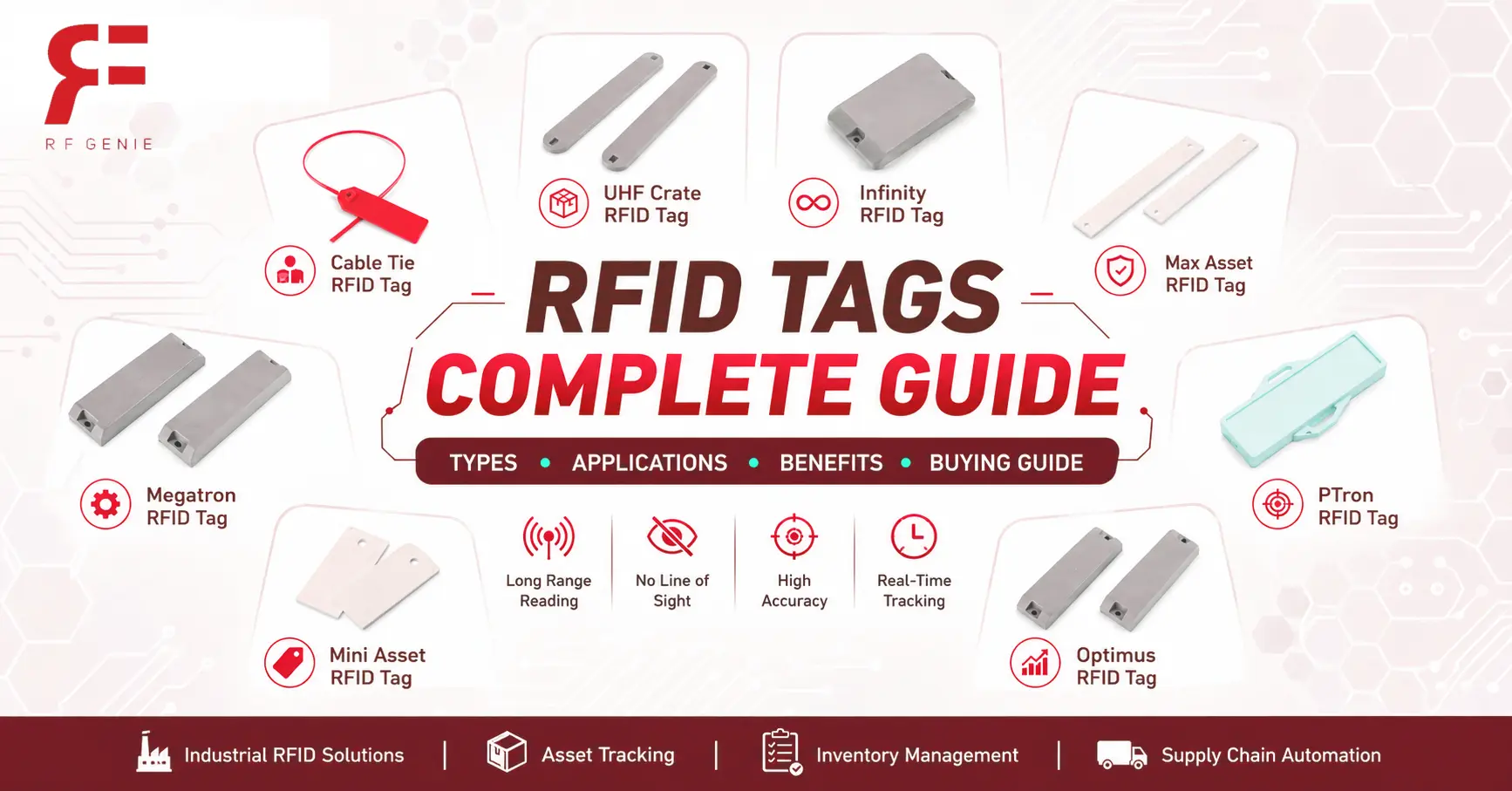
RFID Tags (Radio Frequency Identification Tags) are smart identification devices that use radio waves to automatically identify, track, and manage physical assets, products, or equipment without requiring direct line-of-sight scanning. Each RFID Tag contains a microchip that stores unique data and an antenna that communicates with an RFID Reader. This technology enables businesses to capture information quickly, accurately, and efficiently, making it a preferred solution for modern inventory management, asset tracking, warehouse operations, retail, healthcare, manufacturing, and logistics.
Unlike traditional barcodes, RFID Tags do not need to be visible to the scanner. Multiple RFID Tags can be read simultaneously, even when they are inside cartons, pallets, or storage containers. This significantly reduces manual scanning time and improves operational efficiency.
Today, RFID Tags are widely used by organizations that require real-time visibility of products and assets throughout the supply chain. Whether tracking inventory in a warehouse, monitoring medical equipment in hospitals, managing returnable transport items, or identifying tools in manufacturing facilities, RFID technology provides a faster and more reliable alternative to conventional identification methods
What are RFID Tags?
RFID Tags (Radio Frequency Identification Tags) are smart identification devices that use radio waves to automatically identify, track, and manage physical assets, products, or equipment without requiring direct line-of-sight scanning. Each RFID Tag contains a microchip that stores unique data and an antenna that communicates with an RFID Reader. This technology enables businesses to capture information quickly, accurately, and efficiently, making it a preferred solution for modern inventory management, asset tracking, warehouse operations, retail, healthcare, manufacturing, and logistics.
Unlike traditional barcodes, RFID Tags do not need to be visible to the scanner. Multiple RFID Tags can be read simultaneously, even when they are inside cartons, pallets, or storage containers. This significantly reduces manual scanning time and improves operational efficiency.
Today, RFID Tags are widely used by organizations that require real-time visibility of products and assets throughout the supply chain. Whether tracking inventory in a warehouse, monitoring medical equipment in hospitals, managing returnable transport items, or identifying tools in manufacturing facilities, RFID technology provides a faster and more reliable alternative to conventional identification methods
RFID Tags (Radio Frequency Identification Tags) are smart identification devices that use radio waves to automatically identify, track, and manage physical assets, products, or equipment without requiring direct line-of-sight scanning. Each RFID Tag contains a microchip that stores unique data and an antenna that communicates with an RFID Reader. This technology enables businesses to capture information quickly, accurately, and efficiently, making it a preferred solution for modern inventory management, asset tracking, warehouse operations, retail, healthcare, manufacturing, and logistics.
Unlike traditional barcodes, RFID Tags do not need to be visible to the scanner. Multiple RFID Tags can be read simultaneously, even when they are inside cartons, pallets, or storage containers. This significantly reduces manual scanning time and improves operational efficiency.
Today, RFID Tags are widely used by organizations that require real-time visibility of products and assets throughout the supply chain. Whether tracking inventory in a warehouse, monitoring medical equipment in hospitals, managing returnable transport items, or identifying tools in manufacturing facilities, RFID technology provides a faster and more reliable alternative to conventional identification methods.
What Does an RFID Tag Consist Of?
An RFID Tag is made up of several essential components that work together to store and transmit information:
RFID Microchip (Integrated Circuit)
The microchip is the brain of the RFID Tag. It stores a unique identification number and, depending on the tag type, additional information such as product details, serial numbers, manufacturing data, or asset information. Some RFID Tags are read-only, while others support read and write functionality, allowing data to be updated whenever required.
RFID Antenna
The antenna enables communication between the RFID Tag and the RFID Reader. It receives radio frequency energy from the reader and transmits the stored information back. The antenna design directly affects the tag’s reading distance and overall performance.
Tag Material or Housing
The chip and antenna are protected by various materials depending on the intended application. RFID Tags may be manufactured as adhesive labels, plastic cards, hard tags, flexible tags, rfid hang tags, wristbands, cable tags, or rugged industrial tags for harsh environments [.
Protective Layer
Industrial RFID Tags often include an additional protective layer that safeguards the electronics from dust, moisture, chemicals, vibration, UV exposure, and extreme temperatures. This ensures reliable performance in challenging operating conditions.
How RFID Tags Store Information
Each RFID Tag contains digital memory capable of storing unique identification data. Depending on the application, the memory may include:
- Product identification numbers
- Asset IDs
- Serial numbers
- Batch or lot numbers
- Manufacturing information
- Maintenance history
- Inventory records
- Location-based tracking information
Depending on the tag type, the stored information can either remain permanent or be updated multiple times throughout the product lifecycle.
Why Businesses Choose RFID Tags
Organizations across industries are replacing manual identification methods with RFID technology because it improves speed, accuracy, and operational visibility. RFID Tags help automate repetitive processes while reducing human errors associated with manual barcode scanning.
Key advantages include:
- Contactless identification without direct line-of-sight.
- Simultaneous reading of multiple RFID Tags.
- Faster inventory counting and stock verification.
- Improved asset visibility across facilities.
- Better inventory accuracy and reduced stock discrepancies.
- Enhanced warehouse productivity.
- Real-time asset tracking and monitoring.
- Reduced labour costs through process automation.
- Long operational lifespan for passive RFID Tags.
- Easy integration with ERP, WMS, MES, and inventory management systems.
As industries continue to adopt digital transformation and Industry 4.0 practices, RFID Tags have become an essential technology for improving traceability, operational efficiency, and data-driven decision-making.
At RFGenie, we provide high-performance RFID Tags engineered for a wide range of applications, including inventory management, asset tracking, warehouse automation, retail, healthcare, manufacturing, logistics, and supply chain operations. Our RFID solutions are designed to deliver reliable read performance, durability, and seamless integration with leading RFID hardware and software platforms.
How Do RFID Tags Work?
RFID Tags work by using radio frequency (RF) communication to exchange data with an RFID Reader. Instead of relying on direct visual scanning like traditional barcodes, RFID technology uses electromagnetic waves to identify and track tagged items quickly and accurately. This allows businesses to automate inventory management, asset tracking, warehouse operations, and supply chain processes with minimal manual effort.
A complete RFID system typically consists of four key components:
1. RFID Tag
The RFID Tag is attached to the product, asset, equipment, pallet, carton, or container that needs to be identified or tracked. Each tag contains a microchip that stores a unique identification number and an antenna that enables wireless communication with the RFID Reader.
Depending on the application, RFID Tags can also store additional information such as product details, serial numbers, manufacturing dates, maintenance records, or batch information.
2. RFID Reader
The RFID Reader is responsible for communicating with RFID Tags. It generates radio frequency signals that activate nearby tags, receives the information transmitted by the tags, and sends the collected data to a connected software system.
RFID Readers are available in different configurations, including:
- Fixed RFID Readers for warehouse gates, conveyor systems, production lines, and dock doors.
- Handheld RFID Readers for inventory counting, asset audits, and field operations.
- Desktop RFID Readers for encoding and testing RFID Tags.
- Integrated RFID Readers for automated industrial applications.
3. RFID Antenna
The RFID Antenna creates the radio frequency field used for communication between the RFID Reader and RFID Tags. The antenna determines the coverage area, read direction, and reading performance of the system.
Depending on the installation, antennas may be:
- Circular polarized
- Linear polarized
- Indoor antennas
- Outdoor antennas
- Portal antennas
- Ceiling-mounted antennas
Selecting the correct antenna helps maximize read accuracy and reduce unwanted tag reads.
4. RFID Software
The information collected by the RFID Reader is transferred to RFID software or enterprise applications such as:
- Warehouse Management System (WMS)
- Enterprise Resource Planning (ERP)
- Asset Management Software
- Manufacturing Execution System (MES)
- Inventory Management Software
- Retail Management Systems
The software processes the data and provides real-time visibility into inventory levels, asset locations, stock movements, and operational performance.
Step-by-Step RFID Working Process
Understanding how RFID Tags work becomes easier when broken down into a simple process.
Step 1: The Reader Generates Radio Waves
The RFID Reader continuously emits radio frequency signals through its antenna. These radio waves create a reading zone around the antenna.
Step 2: The RFID Tag Enters the Reading Zone
When an RFID Tag comes within the reader’s operating range, it detects the radio frequency signal.
For passive RFID Tags, this energy powers the microchip. Active RFID Tags use their internal battery to communicate over longer distances.
Step 3: The Tag Sends Its Data
Once activated, the RFID Tag transmits its stored information back to the RFID Reader through its antenna.
The transmitted information may include:
- Unique Tag ID
- Product Code
- Asset Number
- EPC (Electronic Product Code)
- Batch Number
- Serial Number
- User Memory Data
Step 4: Reader Receives the Information
The RFID Reader captures the transmitted data from one or multiple RFID Tags simultaneously.
Unlike barcode systems that scan one label at a time, RFID technology can identify hundreds of tags within seconds, significantly improving operational speed.
Step 5: Software Processes the Data
The collected information is automatically sent to business software, where it is matched with product records, inventory databases, or asset management systems.
Managers can then monitor inventory movement, asset locations, stock availability, production progress, or shipment status in real time.
Can Multiple RFID Tags Be Read at the Same Time?
Yes. One of the biggest advantages of RFID technology is its ability to read multiple RFID Tags simultaneously.
For example:
- A pallet containing hundreds of tagged products can be scanned automatically while passing through a warehouse gate.
- Retail stores can perform inventory counts much faster than with barcode scanners.
- Manufacturing facilities can track work-in-progress items without stopping production.
- Logistics companies can automatically record incoming and outgoing shipments.
This capability helps reduce manual labor, improve inventory accuracy, and increase operational efficiency.
Factors That Affect RFID Performance
The reading performance of an RFID system depends on several factors, including:
- Type of RFID Tag
- Operating frequency (LF, HF, or UHF)
- RFID Reader power
- Antenna design and placement
- Distance between the reader and the tag
- Presence of metal surfaces or liquids
- Environmental conditions such as dust, moisture, and temperature
- Tag orientation relative to the antenna
Choosing the right combination of RFID Tags, readers, antennas, and software is essential for achieving reliable performance.
Why RFID Technology is More Efficient than Traditional Identification Methods
Compared to manual identification methods, RFID technology offers significant operational advantages.
- No direct line-of-sight scanning is required.
- Hundreds of RFID Tags can be read in seconds.
- Faster inventory counts and stock audits.
- Reduced human errors during data collection.
- Real-time asset and inventory visibility.
- Improved warehouse productivity.
- Better traceability throughout the supply chain.
- Easy integration with enterprise software systems.
- Supports automation and Industry 4.0 initiatives.
Types of RFID Tags
RFID Tags are available in different types to meet the requirements of various industries and applications. The right RFID Tag depends on factors such as read range, operating environment, material type, data storage requirements, and budget.
The most common way to classify RFID Tags is based on their power source, operating frequency, and physical design.
RFID Tags Based on Power Source
Passive RFID Tags
Passive RFID Tags are the most widely used type of RFID Tags across industries. These tags do not contain an internal battery. Instead, they receive energy from the radio waves transmitted by an RFID Reader. Once energized, the tag sends its stored information back to the reader.
Because they have a simple design, Passive RFID Tags are lightweight, cost-effective, and require minimal maintenance. They are commonly used for high-volume applications where thousands of products or assets need to be identified and tracked.
Key Features
No internal battery required
Lightweight and compact design
Long operational lifespan
Low maintenance
Cost-effective for large deployments
Supports high-speed inventory scanning
Available in multiple sizes and materials
Common Applications
Inventory Management
Warehouse Management
Retail Product Tracking
Asset Tracking
Library Management
File Tracking
Manufacturing
Supply Chain Management
Logistics
Healthcare Equipment Tracking
Active RFID Tags
Active RFID Tags include an internal battery that continuously powers the microchip and allows the tag to transmit signals over much longer distances than passive tags.
These tags are ideal for tracking high-value assets, vehicles, containers, heavy equipment, and mission-critical assets where continuous visibility is required.
Key Features
Built-in battery
Long read range
Continuous signal transmission
Large memory capacity
Suitable for real-time location tracking
Excellent performance in large facilities
Common Applications
Vehicle Tracking
Fleet Management
Container Tracking
Mining
Oil & Gas
Defence
Aviation
Industrial Asset Management
Smart Manufacturing
Semi-Passive (Battery-Assisted) RFID Tags
Semi-Passive RFID Tags combine the advantages of passive and active RFID technology. They include a battery to power the internal circuitry, while communication with the RFID Reader still relies on backscatter technology.
These tags provide improved reading reliability, especially in environments with metal, liquid, or long reading distances.
Common Applications
Cold Chain Monitoring
Pharmaceutical Tracking
Environmental Monitoring
Temperature Monitoring
Industrial Automation
Food Supply Chain
RFID Tags Based on Frequency
Different RFID systems operate on different frequency bands. Choosing the right frequency is important because it affects read range, speed, and environmental performance.
Low Frequency (LF) RFID Tags
Operating Frequency:
125–134.2 kHz
LF RFID Tags provide stable performance around water and metal and are commonly used where short reading distances are acceptable.
Applications
Animal Identification
Access Control
Attendance Systems
Vehicle Immobilizers
Industrial Identification
Typical Read Range
Up to 10 cm
High Frequency (HF) RFID Tags
Operating Frequency:
13.56 MHz
HF RFID Tags offer moderate reading distances and are widely used in secure identification applications.
Applications
Smart Cards
Library Management
Ticketing
NFC Applications
Healthcare
Access Control
Payment Systems
Typical Read Range
Up to 1 meter
Ultra High Frequency (UHF) RFID Tags
Operating Frequency:
860–960 MHz
UHF RFID Tags provide the longest reading distance among passive RFID technologies and support high-speed reading of multiple tags simultaneously.
These tags are widely used in modern warehouse automation and inventory management systems.
Applications
Warehouse Automation
Inventory Management
Retail
Manufacturing
Distribution Centres
Logistics
Supply Chain
Asset Tracking
Pallet Tracking
Carton Tracking
Typical Read Range
Up to 12 meters (depending on tag, reader, antenna, and environment)
RFID Tags Based on Design
RFID Labels
RFID Labels combine an RFID inlay tags with a printable adhesive label. They are commonly used for cartons, products, packaging, and inventory items.
Suitable for:
Retail
Warehouse
Logistics
Inventory Management
Pharmaceutical Packaging
On-Metal RFID Tags
Standard RFID Tags may experience reduced performance when attached directly to metal surfaces. On-Metal RFID Tags are specially engineered with insulation layers that allow reliable operation on metallic assets.
Applications include:
Machinery
Metal Containers
Steel Racks
Industrial Equipment
IT Assets
Tools
Returnable Transport Items
Hard RFID Tags
Hard RFID Tags are manufactured using durable materials such as ABS plastic, ceramic, or engineering polymers.
They are designed for harsh industrial environments where resistance to impact, chemicals, moisture, vibration, or high temperatures is required.
Applications include:
Manufacturing
Oil & Gas
Construction
Heavy Equipment
Outdoor Assets
RFID Wristbands
RFID Wristbands provide secure and contactless identification for people rather than products.
Common applications include:
Hospitals
Events
Hotels
Water Parks
Fitness Centres
Access Control
RFID Cards
RFID Cards are widely used for secure identification and authentication.
Applications include:
Employee ID Cards
Visitor Management
Hotel Key Cards
Student ID Cards
Corporate Access Control
Which RFID Tag is Right for Your Business?
Selecting the right RFID Tag depends on several technical and operational factors, including:
Asset material (metal, plastic, wood, glass, or liquid)
Required read range
Indoor or outdoor environment
Operating temperature
Required memory capacity
Mounting method
Industry standards
Budget
Reader compatibility
Application requirements
At RFGenie, we help businesses choose the most suitable RFID Tags based on their industry, operational environment, and performance requirements. Whether you need RFID Labels for inventory management, On-Metal RFID Tags for industrial assets, or UHF RFID Tags for warehouse automation, our experts can recommend the ideal solution for your application.
RFID Tags vs Barcode: What’s the Difference?
Businesses often compare RFID Tags and barcodes when selecting an identification and tracking technology. While both are used to identify products and assets, they differ significantly in terms of speed, accuracy, data storage, read range, and automation capabilities.
Barcodes have been used for decades because they are inexpensive and easy to implement. However, as businesses scale and require real-time inventory visibility, faster stock counts, and automated asset tracking, RFID technology has become the preferred solution.
RFID Tags vs Barcode Comparison
| Feature | RFID Tags | Barcode |
|---|---|---|
| Technology | Uses radio frequency signals | Uses printed optical codes |
| Line of Sight | Not required | Required |
| Read Multiple Items | Yes, hundreds of tags simultaneously | No, one barcode at a time |
| Read Speed | Very fast | Slower |
| Read Range | A few centimeters to several meters (depending on tag type) | A few centimeters |
| Data Storage | High capacity, can be rewritten on many tag types | Limited information |
| Durability | Resistant to dirt, moisture, and wear (depending on tag design) | Easily damaged or unreadable if scratched |
| Automation | Excellent for automated processes | Mostly manual scanning |
| Inventory Accuracy | Very high | Depends on manual scanning accuracy |
| Security | Can support unique IDs and access controls | Easy to duplicate or photocopy |
| Cost per Tag | Higher than barcode labels | Very low |
How RFID Tags Improve Inventory Management
One of the biggest advantages of RFID Tags is the ability to scan multiple items simultaneously without opening boxes or manually locating labels.
For example, a warehouse receiving hundreds of cartons can automatically identify every tagged item as it passes through an RFID gate. With barcode systems, each carton must be scanned individually, increasing labour time and the possibility of human error.
This makes RFID technology especially valuable for:
- Inventory management
- Warehouse automation
- Retail stock counting
- Distribution centres
- Manufacturing facilities
- Logistics operations
- Asset tracking
RFID vs Barcode for Asset Tracking
When tracking valuable assets such as laptops, machinery, medical equipment, tools, returnable containers, or vehicles, RFID Tags offer several advantages over traditional barcode labels.
RFID Tags continue to work even when they are:
- Inside a cabinet
- Attached to pallets
- Hidden behind packaging
- Mounted on equipment
- Installed in hard-to-reach locations
Since RFID Readers can detect multiple tags without direct visibility, businesses spend less time searching for assets and more time focusing on operations.
RFID vs Barcode for Warehouse Operations
Modern warehouses process thousands of products every day. Manual barcode scanning often slows receiving, storage, picking, packing, and shipping operations.
RFID Tags enable automated identification throughout the warehouse by:
- Tracking incoming goods at receiving docks
- Monitoring inventory movement between storage zones
- Verifying picked orders
- Recording outbound shipments automatically
- Improving stock visibility in real time
This results in faster operations, fewer errors, and better inventory accuracy.
RFID vs Barcode in Retail
Retail businesses increasingly use RFID technology to improve stock accuracy and customer satisfaction.
Compared with barcode systems, RFID Tags help retailers:
- Perform inventory counts in significantly less time.
- Locate missing products quickly.
- Reduce out-of-stock situations.
- Improve shelf availability.
- Speed up receiving and stock replenishment.
- Support self-checkout and smart retail initiatives.
These benefits contribute to a better shopping experience while improving operational efficiency.
When Should You Choose RFID Tags?
RFID technology is an ideal choice if your business requires:
- Real-time inventory visibility
- Faster stock counting
- Automated warehouse operations
- Asset tracking across multiple locations
- High inventory accuracy
- Reduced manual labour
- Improved supply chain traceability
- Scalable automation for future growth
When is a Barcode Still Suitable?
Barcodes remain a practical option for applications where:
- Budget is the primary concern.
- Products are scanned individually.
- Real-time tracking is not required.
- Inventory volumes are relatively low.
- Automation requirements are minimal.
For many businesses, barcodes continue to work well for basic identification tasks. However, as operations grow in complexity, RFID provides greater efficiency and long-term value.
Why Businesses are Moving from Barcode to RFID
As industries embrace digital transformation, more organizations are replacing barcode-based processes with RFID solutions to achieve higher productivity, better inventory control, and greater operational visibility.
RFID Tags reduce manual effort, improve data accuracy, and support real-time decision-making across warehouses, manufacturing plants, retail stores, healthcare facilities, and logistics networks.
At RFGenie, we help businesses transition from traditional barcode systems to advanced RFID solutions by offering high-performance RFID Tags, RFID Readers, and complete implementation support tailored to specific operational requirements.
Applications of RFID Tags Across Industries
RFID Tags are used across multiple industries to improve identification, tracking, inventory management, and automation processes. From warehouses and manufacturing plants to retail stores, hospitals, logistics networks, and supply chains, RFID technology helps organizations achieve better visibility, higher accuracy, and improved operational efficiency.
The ability of RFID Tags to capture data automatically without direct line-of-sight makes them suitable for applications where traditional barcode systems are slow, difficult to manage, or unable to provide real-time information.
Below are some of the most common applications of RFID Tags across different industries.
RFID Tags for Warehouse and Inventory Management
Warehouses handle thousands of products, cartons, pallets, and assets every day. Managing inventory manually can result in errors, delays, and inaccurate stock information.
RFID Tags enable automated inventory tracking by providing real-time visibility of products throughout warehouse operations.
Common Warehouse Applications:
- Inventory counting and stock verification
- Pallet and carton tracking
- Goods receiving automation
- Shipment verification
- Storage location tracking
- Picking and packing accuracy
- Returnable container tracking
Benefits of RFID in Warehouses:
- Faster inventory audits
- Reduced manual scanning
- Improved stock accuracy
- Real-time inventory visibility
- Reduced shipping errors
- Better warehouse productivity
UHF RFID Tags are commonly preferred for warehouse applications because they provide longer read ranges and can identify multiple items simultaneously.
RFID Tags for Manufacturing Industry
Manufacturing companies require accurate tracking of raw materials, components, tools, and finished products throughout the production process.
RFID Tags support smart manufacturing by enabling real-time monitoring of products as they move through different production stages.
Manufacturing Applications:
- Work-in-progress tracking
- Production line monitoring
- Tool tracking
- Machine maintenance tracking
- Component identification
- Quality control processes
- Finished goods tracking
Benefits for Manufacturing:
- Improved production visibility
- Reduced production delays
- Better traceability
- Automated data collection
- Improved quality management
- Support for Industry 4.0 initiatives
Industrial RFID Tags and On-Metal RFID Tags are commonly used for manufacturing environments where durability and reliable performance are required.
RFID Tags for Retail Industry
Retail businesses use RFID technology to improve inventory accuracy, enhance customer experience, and optimize store operations.
RFID Tags help retailers know exactly what products are available, where they are located, and when they need replenishment.
Retail Applications:
- Apparel tagging
- Product identification
- Inventory management
- Shelf monitoring
- Anti-counterfeiting
- Smart checkout systems
- Omnichannel retail operations
Benefits for Retail:
- Faster stock counting
- Reduced out-of-stock situations
- Improved product availability
- Better customer experience
- Accurate inventory records
RFID Labels and RFID Smart Labels are widely used in retail because they can be easily attached to products and packaging.
RFID Tags for Healthcare Industry
Healthcare organizations require accurate tracking of medical equipment, patient information, medicines, and laboratory assets.
RFID technology helps hospitals improve safety, efficiency, and asset availability.
Healthcare Applications:
- Medical equipment tracking
- Patient identification
- Laboratory sample tracking
- Pharmacy inventory management
- Blood bag tracking
- Surgical instrument management
- Medical record tracking
Benefits in Healthcare:
- Faster equipment locating
- Improved patient safety
- Better asset utilization
- Reduced equipment loss
- Improved operational efficiency
Specialized RFID Tags designed for healthcare environments help ensure reliable identification of critical assets.
RFID Tags for Logistics and Supply Chain
Logistics companies require complete visibility of goods during transportation and distribution.
RFID Tags provide automated tracking of shipments, containers, and assets throughout the supply chain.
Logistics Applications:
- Shipment tracking
- Pallet identification
- Container tracking
- Distribution centre management
- Delivery verification
- Returnable transport item tracking
Supply Chain Benefits:
- Better shipment visibility
- Faster receiving processes
- Reduced tracking errors
- Improved logistics planning
- Enhanced customer satisfaction
RFID solutions help organizations build smarter and more transparent supply chains.
RFID Tags for Automotive Industry
The automotive industry uses RFID Tags to track vehicles, components, tools, and production processes.
Automotive Applications:
- Vehicle identification
- Component tracking
- Assembly line tracking
- Tool management
- Spare parts tracking
- Quality control
Benefits:
- Improved production efficiency
- Better component traceability
- Reduced manufacturing errors
- Faster process monitoring
RFID Tags for IT Asset Tracking
Organizations use RFID Tags to manage expensive IT equipment and infrastructure.
IT Asset Applications:
- Laptop tracking
- Server equipment tracking
- Network equipment identification
- Printer management
- Data centre asset tracking
Benefits:
- Faster asset audits
- Reduced asset loss
- Improved lifecycle management
- Better compliance tracking
RFID Tags for Jewellery and Small Item Tracking
Small and valuable products require accurate identification and security.
Specialized RFID Tags help jewellery retailers track individual items efficiently.
Applications:
- Jewellery inventory
- Watches
- Luxury products
- Small electronic items
- High-value merchandise
Benefits include faster stock checks, improved security, and better inventory control.
RFID Tags for Libraries and Documents
Libraries and organizations managing large volumes of documents use RFID technology for efficient tracking.
Applications include:
- Book identification
- Document tracking
- Automated issue and return systems
- Archive management
RFID helps reduce manual work and improves information management.
RFID Tags for Laundry and Textile Management
Industrial laundry businesses use durable RFID Tags to track garments, uniforms, and reusable textile items.
Applications include:
- Hospital linen tracking
- Uniform management
- Rental textile tracking
- Laundry automation
Special RFID laundry tags are designed to withstand repeated washing and harsh environments.
How to Choose the Right RFID Tag for Your Application?
Selecting the right RFID Tag is essential for achieving accurate identification, reliable tracking, and maximum performance from an RFID system. Since every application has different requirements, the ideal RFID Tag depends on factors such as the type of asset, operating environment, required read range, frequency, mounting surface, and business objective.
A warehouse inventory application may require high-performance UHF RFID Tags for long-distance scanning, while industrial equipment tracking may require durable On-Metal RFID Tags designed for harsh environments.
Before selecting an RFID Tag, businesses should evaluate the following factors.
1. Identify Your Application Requirements
The first step in choosing the right RFID Tag is understanding what you need to track.
Common RFID applications include:
- Inventory tracking
- Asset management
- Warehouse automation
- Manufacturing process tracking
- Retail product identification
- Healthcare equipment tracking
- Logistics and supply chain monitoring
- Tool and equipment management
The application determines the required tag type, size, material, and performance specifications.
2. Consider the Tag Attachment Surface
The surface where an RFID Tag will be applied plays an important role in performance.
Non-Metal Surfaces
For products made of:
- Plastic
- Cardboard
- Wood
- Paper
- Glass
standard RFID Labels and RFID Smart Labels usually provide excellent performance.
Metal Surfaces
Metal can interfere with RFID communication and reduce reading performance. For metallic assets, specially designed On-Metal RFID Tags are recommended.
Common applications:
- Machinery
- Industrial tools
- IT equipment
- Metal containers
- Automotive components
3. Select the Right RFID Frequency
RFID Tags operate at different frequency ranges, and each frequency has specific advantages.
LF RFID Tags
Suitable for:
- Short-range identification
- Animal tracking
- Access control
- Industrial applications
HF RFID Tags
Suitable for:
- Smart cards
- NFC applications
- Library systems
- Healthcare identification
UHF RFID Tags
Suitable for:
- Warehouse inventory
- Retail
- Logistics
- Asset tracking
- Supply chain management
UHF RFID Tags are widely preferred for applications requiring longer read distances and faster identification of multiple items.
4. Determine Required Read Range
Read range refers to the distance from which an RFID Reader can identify a tag.
Factors affecting read range include:
- RFID Tag type
- Reader power
- Antenna configuration
- Installation environment
- Tag orientation
- Surrounding materials
For example:
- Small product tracking may require short-range RFID Tags.
- Warehouse pallet tracking may require long-range UHF RFID Tags.
- Large asset tracking may require active RFID Tags.
5. Evaluate Environmental Conditions
The operating environment directly impacts RFID Tag selection.
Consider conditions such as:
- Temperature
- Moisture
- Dust
- Chemicals
- Outdoor exposure
- Mechanical impact
- Vibration
For demanding environments, businesses may require:
- Industrial RFID Tags
- Rugged RFID Tags
- Waterproof RFID Tags
- Heat-resistant RFID Tags
- Chemical-resistant RFID Tags
6. Decide Between Standard and Custom RFID Tags
Every business has unique tracking requirements. Standard RFID Labels may be suitable for general applications, but some industries require customized solutions.
Custom RFID Tags can include:
- Specific dimensions
- Special adhesive options
- Custom materials
- Logo printing
- Unique encoding requirements
- Special protection layers
- Application-specific designs
RFGenie provides customized RFID Tag solutions based on operational requirements and industry needs.
7. Check RFID Reader Compatibility
Before selecting RFID Tags, ensure compatibility with your RFID Reader and software system.
Important considerations include:
- Supported frequency
- RFID standard compatibility
- Read/write capability
- Memory requirements
- Data format
A properly matched RFID Tag and RFID Reader combination ensures better accuracy and system performance.
8. Consider Memory Requirements
Different RFID Tags offer different memory capacities.
Depending on the application, businesses may require memory for:
- Unique identification numbers
- Product information
- Serial numbers
- Maintenance records
- Manufacturing data
- Tracking history
Simple identification applications may require minimal memory, while industrial applications may need additional storage capacity.
9. Evaluate Durability and Lifecycle
The expected lifespan of an RFID Tag depends on the application environment.
For temporary applications:
- RFID Labels may be sufficient.
For long-term asset tracking:
- Hard RFID Tags
- Industrial RFID Tags
- Encapsulated RFID Tags
may provide better durability.
Choosing the right durability level prevents frequent replacement and reduces long-term operational costs.
RFID Tag Price in India: Factors Affecting Cost
The price of an RFID Tag depends on various factors such as tag type, frequency, material, memory capacity, read range, customization requirements, and application environment. Since RFID Tags are available in different designs and specifications, there is no fixed price for every application.
Businesses should select RFID Tags based on performance requirements rather than only focusing on the lowest cost. Choosing the correct RFID Tag ensures better reliability, longer lifecycle, and improved return on investment.
At RFGenie, we provide RFID Tag solutions for different industries and applications, including inventory management, asset tracking, warehouse automation, manufacturing, retail, healthcare, and logistics.
Factors That Affect RFID Tag Price
1. RFID Tag Type
The type of RFID Tag has a major impact on pricing.
Common RFID Tag types include:
- Passive RFID Tags
- Active RFID Tags
- Semi-Passive RFID Tags
- RFID Labels
- Hard RFID Tags
- On-Metal RFID Tags
- Industrial RFID Tags
Passive RFID Tags are generally more affordable for high-volume applications, while active and specialized industrial RFID Tags may have higher costs due to additional components and advanced features.
2. RFID Frequency
RFID Tags are available in different frequency ranges:
LF RFID Tags
Used for short-range applications such as access control and identification.
HF RFID Tags
Commonly used for smart cards, NFC applications, healthcare, and library systems.
UHF RFID Tags
Widely used for warehouse, retail, logistics, and inventory management because of their longer read range.
The selected frequency affects the tag design, performance, and overall cost.
3. Material and Construction
The material used to manufacture an RFID Tag influences its durability and price.
Standard RFID Labels may use paper or synthetic materials, while industrial applications may require:
- ABS plastic housing
- Waterproof materials
- Heat-resistant materials
- Chemical-resistant protection
- Metal-compatible designs
Rugged RFID Tags designed for harsh environments usually cost more because of their enhanced durability.
4. Memory Capacity
RFID Tags are available with different memory options.
Basic applications may only require a unique identification number, while advanced applications may need additional memory for:
- Product information
- Serial numbers
- Manufacturing details
- Maintenance records
- Tracking history
Higher memory capacity can influence RFID Tag pricing.
5. Customization Requirements
Custom RFID Tags are designed according to specific business requirements.
Customization may include:
- Custom dimensions
- Logo printing
- Special adhesive
- Unique encoding
- Special packaging
- Application-specific design
- Environmental protection
Custom RFID Tags may have different pricing depending on design complexity and order quantity.
6. Order Quantity
RFID Tag pricing is also affected by order volume.
Large-scale deployments generally benefit from better pricing because manufacturing and encoding processes become more efficient at higher quantities.
Businesses should consider their current and future RFID requirements when planning purchases.
7. RFID Encoding and Personalization
Some applications require RFID Tags to be pre-programmed before delivery.
Encoding services may include:
- Unique EPC numbers
- Product IDs
- Asset information
- Serial number assignment
- Database integration
Additional personalization requirements can affect the final RFID Tag cost.
Average RFID Tag Cost Considerations
The cost of RFID Tags varies depending on the application:
| RFID Tag Type | Common Applications | Cost Range |
|---|---|---|
| RFID Labels | Retail, inventory, packaging | Low cost |
| Passive RFID Tags | Warehouses, asset tracking | Low to medium cost |
| UHF RFID Tags | Logistics, supply chain | Medium cost |
| On-Metal RFID Tags | Industrial assets | Medium to high cost |
| Active RFID Tags | Real-time tracking | Higher cost |
Actual pricing depends on specifications, quantity, customization, and application requirements.
RFID Standards and Technologies
RFID technology works according to internationally recognized standards that ensure compatibility between RFID Tags, RFID Readers, antennas, and software systems. These standards define how devices communicate, how data is stored, and how RFID systems operate across different industries.
Understanding RFID standards is important when selecting RFID Tags because it ensures that the tags will work correctly with existing RFID hardware and provide reliable performance.
The most commonly used RFID standards include EPC Gen2, ISO standards, and NFC-based technologies.
EPC Gen2 RFID Standard
EPC Gen2 (Electronic Product Code Generation 2) is one of the most widely adopted standards for UHF RFID systems.
It is developed by GS1 and is commonly used for supply chain, logistics, retail, and inventory management applications.
EPC Gen2 RFID technology enables:
- Fast identification of multiple RFID Tags
- Long-range communication
- Global tag identification
- Compatibility between different RFID manufacturers
- Efficient inventory tracking
Most UHF RFID Tags used in warehouses, retail stores, and logistics operations are based on EPC Gen2 standards.
ISO RFID Standards
ISO (International Organization for Standardization) has developed several standards that define RFID communication methods and applications.
Common RFID-related ISO standards include:
ISO 18000 Series
The ISO 18000 family defines air interface standards for RFID communication at different frequencies.
It covers:
- LF RFID systems
- HF RFID systems
- UHF RFID systems
These standards help ensure compatibility between RFID Tags and RFID Readers from different manufacturers.
ISO 14443
ISO 14443 is commonly associated with high-frequency contactless smart card technology.
Applications include:
- Access cards
- Payment systems
- Identification cards
- NFC-based applications
ISO 15693
ISO 15693 is used for HF RFID applications requiring longer reading distances compared to some other HF technologies.
Applications include:
- Library management
- Document tracking
- Industrial identification
- Asset management
UHF RFID Technology
UHF RFID operates in the frequency range of approximately 860–960 MHz and is widely used for applications requiring longer read distances and fast identification.
UHF RFID Tags are commonly used in:
- Warehouses
- Retail inventory
- Supply chain management
- Manufacturing
- Logistics
- Pallet tracking
- Asset tracking
Advantages of UHF RFID include:
- Longer read range
- High-speed tag reading
- Ability to read multiple tags simultaneously
- Cost-effective deployment for large-scale applications
Because of these advantages, UHF RFID has become one of the most popular choices for modern inventory and tracking systems.
RFID vs NFC Technology
RFID and NFC tags are closely related technologies, but they are designed for different applications.
NFC (Near Field Communication) is a specialized form of RFID technology that operates at 13.56 MHz and is designed for short-range communication.
RFID
Common applications:
- Inventory tracking
- Warehouse automation
- Asset management
- Logistics
- Supply chain tracking
Typical characteristics:
- Longer reading distance
- Multiple tag reading
- Industrial applications
NFC
Common applications:
- Mobile payments
- Smart cards
- Access control
- Smartphone interactions
- Digital identity
Typical characteristics:
- Very short reading distance
- Secure communication
- Consumer-focused applications
While NFC is a type of RFID technology, traditional RFID systems are generally better suited for industrial tracking and large-scale identification.
RFID Data Security
Security requirements vary depending on the application.
RFID systems can include security features such as:
- Unique tag identification numbers
- Password protection
- Encrypted communication
- Access controls
- Secure authentication
For applications involving sensitive information, organizations should select RFID technologies with appropriate security capabilities.
Choosing the Right RFID Technology
The correct RFID technology depends on:
- Required reading distance
- Application environment
- Data requirements
- Security requirements
- Industry standards
- Existing RFID infrastructure
For example:
- Retail inventory commonly uses UHF RFID Tags.
- Access cards often use HF RFID technology.
- Industrial identification may require rugged RFID Tags.
- Mobile interactions often use NFC-enabled RFID solutions.
RFID Tags for Asset Tracking and Inventory Management
Managing thousands of assets and inventory items manually can be challenging for businesses. Equipment location, stock availability, product movement, and asset history become difficult to monitor as organizations grow.
RFID Tags for asset tracking and inventory management provide an automated solution that helps businesses identify, monitor, and manage physical assets with greater accuracy and efficiency.
By attaching RFID Tags to products, equipment, tools, containers, or inventory items, organizations can create real-time visibility across their operations.
What is RFID Asset Tracking?
RFID Asset Tracking is a technology-based system that uses RFID Tags, RFID Readers, and software platforms to identify and monitor valuable assets throughout their lifecycle.
Unlike manual tracking methods, RFID asset tracking allows businesses to quickly locate, verify, and manage assets without requiring physical inspection of every item.
Assets that can be tracked using RFID include:
- Industrial equipment
- Tools and machinery
- IT assets
- Medical equipment
- Vehicles
- Returnable containers
- Pallets
- Documents
- Electronics
- High-value inventory
How RFID Asset Tracking Works
An RFID asset tracking system generally includes three main components:
RFID Tags
RFID Tags are attached to assets and store unique identification information.
Depending on the asset type, businesses may use:
- RFID Labels
- Hard RFID Tags
- On-Metal RFID Tags
- Industrial RFID Tags
- Active RFID Tags
RFID Readers
RFID Readers capture information from nearby tags and transmit the data to the tracking system.
Readers may be:
- Fixed RFID Readers
- Handheld RFID Readers
- Mobile RFID Readers
RFID Tracking Software
The software collects RFID data and provides visibility into:
- Asset location
- Movement history
- Usage records
- Maintenance schedules
- Inventory status
Benefits of RFID Asset Tracking
Improved Asset Visibility
RFID technology provides accurate information about where assets are located and how they are being used.
Businesses can quickly answer questions such as:
- Where is the equipment?
- Who is using the asset?
- When was it moved?
- Is maintenance required?
Reduced Asset Loss
Lost or misplaced assets create unnecessary expenses.
RFID tracking helps organizations reduce asset loss by maintaining accurate records of asset movement and ownership.
Faster Asset Audits
Traditional asset audits require manual checking, which can take days or weeks.
With RFID Readers, organizations can scan multiple tagged assets quickly, reducing audit time significantly.
Better Asset Utilization
RFID data helps businesses understand:
- Asset usage frequency
- Idle equipment
- Maintenance requirements
- Replacement needs
This allows organizations to maximize the value of existing assets.
RFID Tags for Inventory Management
Inventory management is one of the most common applications of RFID technology.
RFID Inventory Management systems help businesses automatically track products from manufacturing to storage and final delivery.
Applications include:
- Warehouse inventory tracking
- Retail stock management
- Raw material tracking
- Finished goods monitoring
- Shipment verification
- Production inventory control
How RFID Improves Inventory Accuracy
Traditional inventory methods often depend on manual counting, which can result in inaccurate records.
RFID Tags improve inventory accuracy by:
- Automatically identifying products
- Reducing manual counting errors
- Updating inventory records instantly
- Tracking stock movement
- Improving replenishment planning
RFID Inventory Management in Warehouses
Modern warehouses use RFID Tags to automate critical operations.
RFID applications include:
Receiving
Products entering the warehouse can be automatically identified and recorded.
Storage
Inventory locations can be monitored for better warehouse organization.
Picking
RFID helps verify that the correct products are selected.
Shipping
Outgoing shipments can be automatically checked to reduce errors.
RFID Tags for Different Asset Types
RFID Tags for Metal Assets
Metal surfaces can interfere with normal RFID communication. On-Metal RFID Tags are specially designed for:
- Machinery
- Tools
- IT equipment
- Industrial components
RFID Tags for Outdoor Assets
Outdoor environments require durable RFID Tags that can withstand:
- Rain
- Dust
- Temperature changes
- UV exposure
RFID Tags for Small Assets
Compact RFID Tags are suitable for:
- Electronics
- Medical instruments
- Small tools
- Retail products
Industries Using RFID Asset Tracking Solutions
RFID asset tracking is widely used in:
Manufacturing
Tracking:
- Tools
- Components
- Production equipment
- Work-in-progress materials
Healthcare
Tracking:
- Medical devices
- Surgical instruments
- Hospital equipment
IT Management
Tracking:
- Computers
- Servers
- Network equipment
Logistics
Tracking:
- Containers
- Pallets
- Returnable transport items
Retail
Tracking:
- Products
- Inventory
- High-value items
RFID Tags for Different Industries and Use Cases
RFID technology is used across industries where businesses need accurate identification, tracking, and automation. From manufacturing components and pharmaceutical products to jewellery items and agricultural assets, RFID Tags help organizations improve visibility, reduce manual effort, and maintain accurate records.
Different industries require different RFID Tag designs based on factors such as asset type, environment, reading distance, durability, and regulatory requirements.
RFID Tags for Automotive Industry
The automotive industry involves complex supply chains, thousands of components, and highly controlled manufacturing processes. RFID Tags help automotive manufacturers track parts, tools, vehicles, and production activities.
Automotive RFID Applications:
- Component tracking
- Vehicle identification
- Assembly line tracking
- Tool management
- Spare parts management
- Work-in-progress tracking
- Quality inspection tracking
Benefits:
- Improved production visibility
- Better component traceability
- Reduced assembly errors
- Faster inventory verification
- Improved supply chain management
Industrial RFID Tags and durable RFID solutions are commonly used in automotive environments where reliability and resistance are required.
RFID Tags for Pharmaceutical Industry
The pharmaceutical industry requires accurate tracking, security, and traceability of medicines, samples, and medical products.
RFID technology helps pharmaceutical companies maintain better control over products throughout the supply chain.
Pharmaceutical Applications:
- Medicine tracking
- Batch identification
- Laboratory sample tracking
- Cold chain monitoring
- Medical inventory management
- Anti-counterfeiting solutions
Benefits:
- Improved product traceability
- Better inventory control
- Reduced risk of errors
- Faster product verification
- Enhanced supply chain visibility
Specialized RFID Tags can be selected for temperature-sensitive and controlled environments.
RFID Tags for Jewellery Industry
Jewellery businesses handle high-value products that require accurate inventory management and security.
Small RFID Tags help retailers track individual jewellery items without affecting product appearance.
Jewellery Applications:
- Gold jewellery tracking
- Diamond inventory management
- Watch tracking
- Product identification
- Display management
Benefits:
- Faster inventory counting
- Reduced manual errors
- Better product visibility
- Improved security
- Easy stock verification
Compact RFID Labels and specialized RFID Tags are commonly used for jewellery applications.
RFID Tags for Textile and Apparel Industry
The textile and apparel industry uses RFID technology to manage large volumes of garments and improve inventory accuracy.
RFID Tags are often integrated into clothing labels and product packaging.
Textile Applications:
- Garment tracking
- Apparel inventory management
- Production tracking
- Warehouse operations
- Distribution management
- Retail stock monitoring
Benefits:
- Faster stock counting
- Better size and color availability
- Reduced inventory differences
- Improved customer experience
- Efficient supply chain management
RFID Smart Labels are widely used in apparel retail because they are lightweight and easy to attach.
RFID Tags for Agriculture Industry
Agriculture and livestock management are increasingly adopting RFID technology for identification and monitoring.
Agricultural Applications:
- Animal identification
- Livestock tracking
- Equipment tracking
- Supply chain monitoring
- Product traceability
Benefits:
- Better record management
- Improved traceability
- Faster identification
- Automated data collection
LF and specialized RFID Tags are commonly used for animal identification applications.
RFID Tags for Library Management
Libraries use RFID technology to automate book identification, borrowing, and inventory management.
Library Applications:
- Book tracking
- Automated issue and return
- Shelf management
- Document identification
- Inventory audits
Benefits:
- Faster book searching
- Reduced manual work
- Improved user experience
- Accurate inventory records
HF RFID Tags are commonly used in library management systems.
RFID Tags for Banking and Financial Institutions
Financial organizations manage sensitive documents, assets, and equipment that require secure tracking.
Applications:
- Document tracking
- File management
- IT asset tracking
- Equipment identification
Benefits:
- Better document visibility
- Improved security
- Faster audits
- Reduced asset loss
RFID Tags for Education Sector
Educational institutions use RFID technology to manage students, assets, and library resources.
Applications:
- Library management
- Student identification
- Equipment tracking
- Attendance systems
Benefits:
- Automated identification
- Improved security
- Better resource management
RFID Tags for Construction Industry
Construction sites contain expensive tools, machinery, and materials that require effective tracking.
Applications:
- Tool tracking
- Equipment management
- Material tracking
- Safety equipment identification
Benefits:
- Reduced equipment loss
- Better utilization
- Improved project management
Choosing Industry-Specific RFID Tags
Every industry has unique tracking requirements. The right RFID Tag depends on:
- Application environment
- Required read range
- Asset material
- Durability requirements
- Frequency selection
- Data storage needs
- Installation method
For example:
- Warehouses often use UHF RFID Tags for long-range inventory tracking.
- Metal industries require On-Metal RFID Tags.
- Healthcare may require specialized durable tags.
- Retail commonly uses RFID Labels and Smart Labels.
RFGenie RFID Solutions for Multiple Industries
RFGenie provides RFID Tag solutions designed for businesses across different sectors. Our RFID products support:
- Asset tracking
- Inventory management
- Warehouse automation
- Manufacturing operations
- Retail applications
- Healthcare tracking
- Logistics management
By selecting the right RFID Tag technology, businesses can improve visibility, automate processes, and build smarter operations.
RFID Tag Installation, Encoding and Maintenance Guide
Proper installation, encoding, and maintenance of RFID Tags are important for achieving accurate identification and reliable performance. Even high-quality RFID Tags may not perform effectively if they are installed incorrectly, placed on unsuitable materials, or configured without considering the application environment.
A successful RFID implementation requires the right combination of RFID Tags, RFID Readers, antennas, software, and installation practices.
RFID Tag Installation Process
The installation process depends on the type of RFID Tag, the asset being tracked, and the operating environment.
1. Identify the Tag Placement Location
Before applying an RFID Tag, businesses should determine the best mounting position.
Important considerations include:
- Surface material
- Reading distance
- Reader location
- Tag orientation
- Environmental exposure
- Accessibility
For example, metal surfaces require specially designed On-Metal RFID Tags to maintain reliable communication.
2. Select the Correct RFID Tag Type
Different applications require different RFID Tag designs.
Examples:
For Inventory Products
Suitable options:
- RFID Labels
- RFID Smart Labels
- UHF RFID Tags
For Industrial Equipment
Suitable options:
- Hard RFID Tags
- On-Metal RFID Tags
- Rugged RFID Tags
For Long-Term Asset Tracking
Suitable options:
- Durable RFID Tags
- Encapsulated RFID Tags
Choosing the correct tag improves read accuracy and reduces replacement requirements.
3. Apply the RFID Tag Correctly
Proper attachment is essential for consistent performance.
Best practices include:
- Clean the mounting surface before application.
- Avoid placing tags near interference sources.
- Ensure proper adhesive bonding.
- Follow manufacturer recommendations.
- Maintain correct tag orientation.
Incorrect placement can reduce RFID read performance.
RFID Tag Encoding and Programming
RFID Tag encoding refers to writing information into the RFID Tag memory before or during deployment.
Depending on the tag type, information can include:
- Unique identification number
- EPC code
- Product information
- Asset ID
- Serial number
- Batch information
- Manufacturing details
RFID Tag Encoding Process
The general encoding process includes:
Step 1: Connect RFID Reader
An RFID Reader with encoding capability is connected to the RFID software system.
Step 2: Select Tag Information
The required data format is prepared based on the application.
Step 3: Write Data to RFID Tag
The RFID Reader transfers the information into the tag memory.
Step 4: Verify Encoding
The system checks whether the data has been successfully written and stored.
RFID Tag Memory Types
RFID Tags may contain different memory areas depending on their design.
Common memory types include:
EPC Memory
Stores the unique identification code used for tracking products and assets.
User Memory
Stores additional information required by the application.
TID Memory
Contains manufacturer-specific information about the RFID chip.
Reserved Memory
Stores security-related information such as passwords.
RFID Tag Maintenance Best Practices
Although many RFID Tags require minimal maintenance, proper management helps maximize system reliability.
Regular Performance Testing
Businesses should periodically check:
- Tag readability
- Reader performance
- Antenna alignment
- Software connectivity
Monitor Damaged Tags
RFID Tags exposed to harsh environments should be inspected regularly.
Replace tags that are:
- Physically damaged
- Detached from assets
- No longer readable
Maintain RFID Database Accuracy
The RFID system database should be updated regularly to ensure:
- Correct asset information
- Accurate inventory records
- Proper ownership details
- Updated tracking history
Common RFID Implementation Challenges
Businesses may face challenges during RFID deployment, including:
Metal and Liquid Interference
Metal and liquids can affect RFID signals.
Solution:
Use application-specific RFID Tags such as:
- On-Metal RFID Tags
- Specialized industrial RFID Tags
Incorrect Tag Selection
Using the wrong RFID Tag type can result in poor performance.
Solution:
Evaluate:
- Environment
- Read range
- Material
- Application requirements
before selecting the tag.
Reader Placement Issues
Poor RFID Reader and antenna positioning can reduce coverage.
Solution:
Conduct testing and optimize reader placement before full deployment.
RFID Implementation Best Practices
For successful RFID deployment:
- Define clear tracking objectives.
- Select suitable RFID Tags.
- Test tags in real operating conditions.
- Integrate RFID software with existing systems.
- Train employees.
- Monitor system performance regularly.
A properly designed RFID system delivers better accuracy, automation, and long-term value.
RFGenie RFID Implementation Support
RFGenie helps businesses implement reliable RFID solutions by providing:
- Application analysis
- RFID Tag selection support
- Custom RFID Tag solutions
- RFID system integration guidance
- Inventory and asset tracking solutions
Whether you need RFID Tags for warehouse automation, manufacturing tracking, retail inventory, or industrial asset management, RFGenie provides solutions designed around your operational requirements.
Frequently Asked Questions About RFID Tags
What are RFID Tags?
RFID Tags are electronic identification devices that use radio frequency technology to store and transmit information to an RFID Reader. They are used for tracking products, assets, equipment, and inventory across industries such as manufacturing, retail, healthcare, logistics, and warehousing.
How do RFID Tags work?
RFID Tags work by communicating with RFID Readers through radio frequency signals. The reader sends energy to the tag, which responds by transmitting its stored identification data. The information is then processed by RFID software for tracking and management purposes.
How do RFID Tags work?
RFID Tags work by communicating with RFID Readers through radio frequency signals. The reader sends energy to the tag, which responds by transmitting its stored identification data. The information is then processed by RFID software for tracking and management purposes.
What are the different types of RFID Tags?
The main types of RFID Tags include:
- Passive RFID Tags
- Active RFID Tags
- Semi-Passive RFID Tags
- UHF RFID Tags
- HF RFID Tags
- LF RFID Tags
- RFID Labels
- On-Metal RFID Tags
- Industrial RFID Tags
The right type depends on the application, environment, and required read range.
What is the difference between Passive and Active RFID Tags?
Passive RFID Tags do not have an internal battery and receive power from the RFID Reader. They are cost-effective and commonly used for inventory and asset tracking.
Active RFID Tags contain a battery that allows longer reading distances and continuous signal transmission. They are used for applications requiring real-time tracking.
Do RFID Tags require a battery?
Not all RFID Tags require batteries.
Passive RFID Tags receive power from the RFID Reader, while Active RFID Tags use internal batteries. Semi-Passive RFID Tags use batteries for specific functions but communicate using reader signals.
Can RFID Tags be reused?
Some RFID Tags can be reused depending on their design and application.
Reusable RFID Tags are commonly used for:
- Returnable containers
- Industrial assets
- Equipment tracking
Disposable RFID Labels are generally designed for single-use applications.
What is the difference between RFID Tags and Barcodes?
RFID Tags use radio frequency communication, while barcodes use optical scanning technology.
Key differences:
- RFID does not require line-of-sight.
- RFID can read multiple items simultaneously.
- RFID stores more data.
- Barcode systems are usually lower cost but require individual scanning.
What are UHF RFID Tags used for?
UHF RFID Tags are commonly used for applications requiring long reading distances and fast identification.
Common uses include:
- Warehouse inventory
- Retail tracking
- Logistics
- Supply chain management
- Asset tracking
- Pallet tracking
What are RFID Tags used for?
UHF RFID Tags are commonly used for applications requiring long reading distances and fast identification.
Common uses include:
- Warehouse inventory
- Retail tracking
- Logistics
- Supply chain management
- Asset tracking
- Pallet tracking
Why Choose RFGenie for RFID Tags and RFID Solutions?
Choosing the right RFID partner is important for building a reliable tracking and automation system. Businesses require RFID solutions that provide accurate identification, consistent performance, and compatibility with their operational requirements.
RFGenie provides advanced RFID Tag solutions designed for industries including manufacturing, retail, logistics, healthcare, warehousing, automotive, and asset management.
Our focus is to help businesses improve visibility, automate processes, and achieve better control over their products, inventory, and assets.
Complete Range of RFID Tag Solutions
RFGenie offers RFID solutions for different applications, including:
RFID Labels
Suitable for:
- Product identification
- Retail inventory
- Warehouse tracking
- Packaging applications
UHF RFID Tags
Ideal for:
- Long-range tracking
- Inventory management
- Supply chain applications
- Warehouse automation
On-Metal RFID Tags
Designed for:
- Industrial equipment
- Machinery tracking
- IT asset management
- Metal surface applications
Industrial RFID Tags
Built for challenging environments such as:
- Manufacturing plants
- Outdoor assets
- Heavy equipment
- Industrial operations
Custom RFID Tags
RFGenie provides customized RFID solutions based on:
- Asset type
- Environmental conditions
- Required read range
- Application requirements
- Business objectives
Why Businesses Choose RFID Solutions from RFGenie
Application-Based RFID Recommendations
Every business has different tracking requirements. RFGenie helps customers select suitable RFID Tags based on their application, environment, and operational goals.
Reliable RFID Performance
The right RFID Tag selection ensures:
- Accurate identification
- Better read performance
- Reduced tracking errors
- Improved operational efficiency
Industry-Specific Solutions
RFGenie supports RFID applications across multiple industries:
- Manufacturing
- Retail
- Healthcare
- Logistics
- Automotive
- Warehousing
- IT asset management
Customized RFID Solutions
Different businesses require different tag designs. RFGenie provides customized RFID Tags according to specific operational needs.
Customization options may include:
- Size and shape
- Material selection
- Adhesive options
- Printing requirements
- RFID encoding
- Environmental protection
Support for RFID Implementation
RFID deployment involves more than selecting tags. A successful solution requires proper planning, testing, and integration.
RFGenie helps businesses with:
- RFID Tag selection
- Application guidance
- Tracking solution planning
- RFID implementation support
Industries We Serve
RFGenie RFID solutions are used by businesses in:
Manufacturing
For production tracking, tools, components, and equipment management.
Logistics and Warehousing
For inventory control, pallet tracking, and supply chain visibility.
Retail
For product identification, stock management, and customer experience improvement.
Healthcare
For medical equipment tracking and inventory management.
Automotive
For component identification and production monitoring.
IT Asset Management
For tracking computers, servers, and infrastructure assets.
Get the Right RFID Tag Solution for Your Business
Whether you need RFID Tags for inventory management, asset tracking, warehouse automation, manufacturing, retail, or logistics, selecting the right RFID solution can improve accuracy and efficiency.
RFGenie provides reliable RFID Tags and customized RFID solutions designed according to your business requirements.
Contact RFGenie today to discuss your RFID application and find the right tracking solution for your organization.