
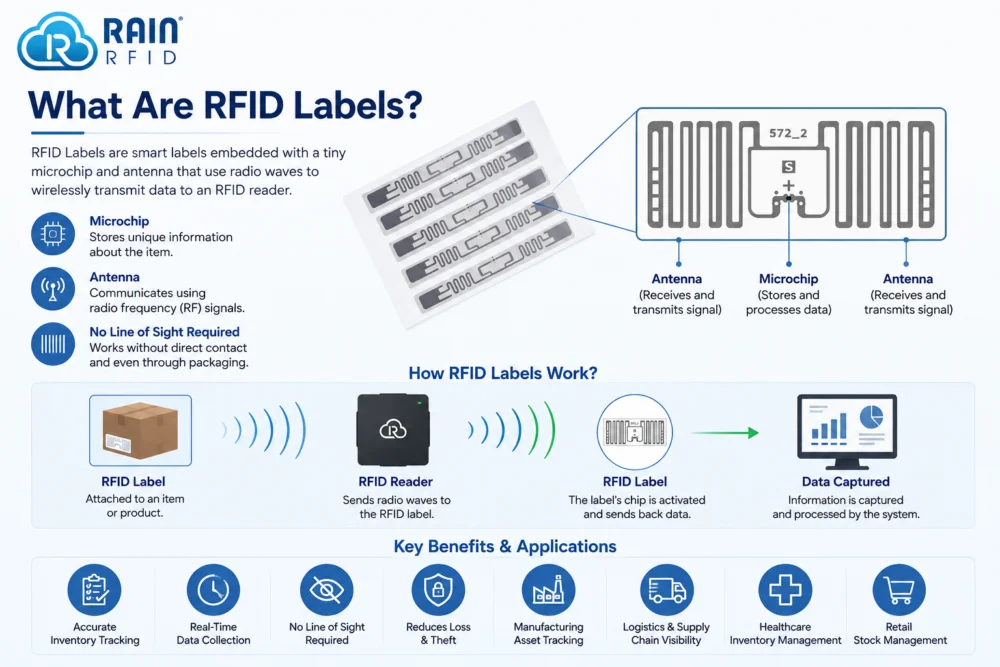
RFID Tags & RFID Labels are smart identification solutions used for inventory management, asset tracking, supply chain visibility, access control and business automation. RF Genie provides reliable RFID tag and label solutions that help businesses improve tracking accuracy, reduce manual work and manage assets more efficiently across industries like manufacturing, retail, healthcare, logistics and IT.
Elevate tracking precision with our RFID tags. Enhance inventory control and streamline operations effortlessly. Our RFID tags for inventory and asset tracking are designed to optimize your tracking and identification systems. Experience seamless integration and reliable data capture with Tagmatiks RFID Tags and Labels for enhanced inventory management, logistics, and access control. Unlock efficiency with precision in every tag and label. Upgrade to advanced UHF RFID tags solutions today.
-
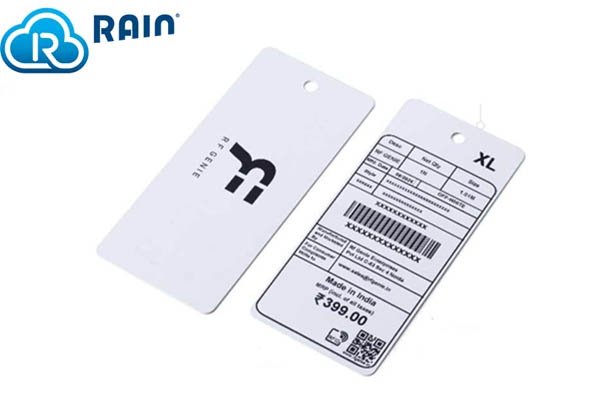
UHF Hang Tag 10245 – rfgenie
Download Datasheet -
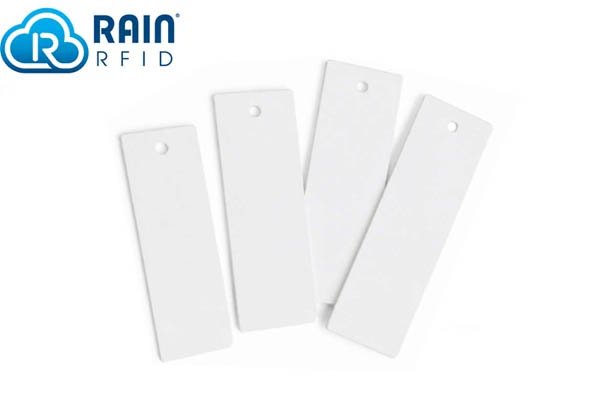
UHF Hang Tag 8325 rfgenie
Download Datasheet -
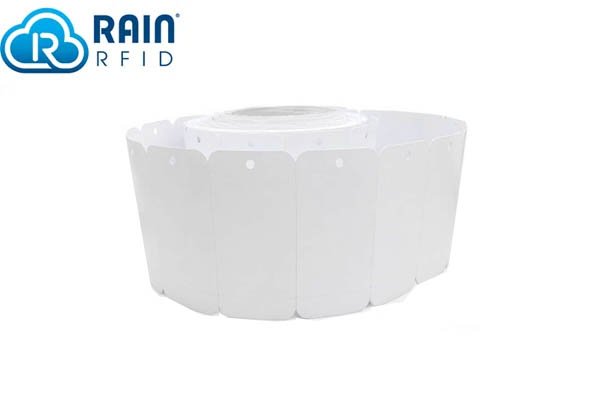
UHF Hang Tag 9648 – Roll
Download Datasheet -
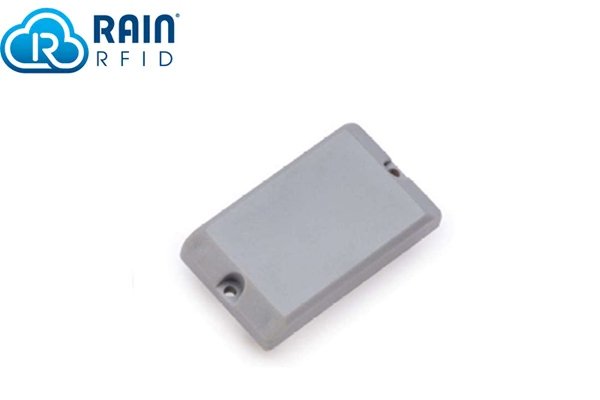
UHF Infinity Tag for Long Range RFID Asset Tracking
Download Datasheet -
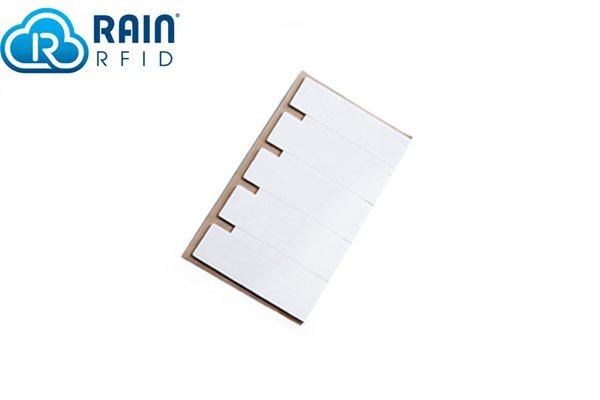
Max-On Metal UHF Label for Metal Asset Tracking
Download Datasheet -

RFID Printer – Zebra ZT400 series industrial RFID Printer
Download Datasheet -
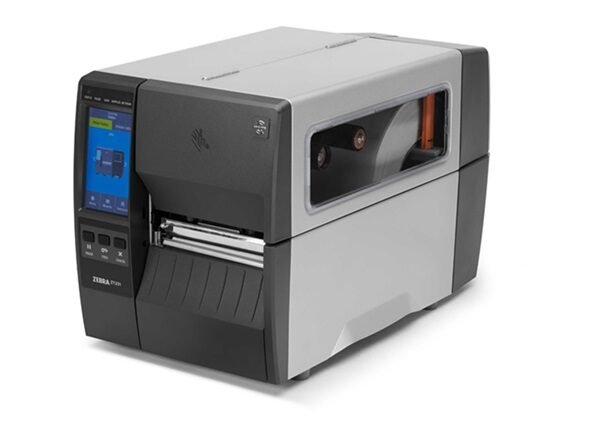
RFID Printer – Zebra ZT231 Series Industrial RFID Printer
Download Datasheet -
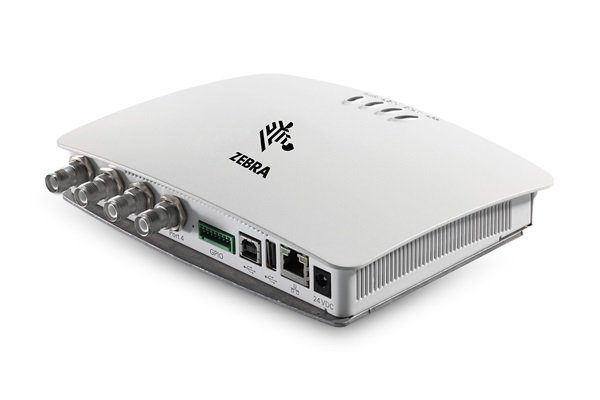
Zebra FX7500 RFID UHF Fixed Reader for Industrial Tracking
Download Datasheet
Ask about product or Report an issue
What is an RFID Tag?
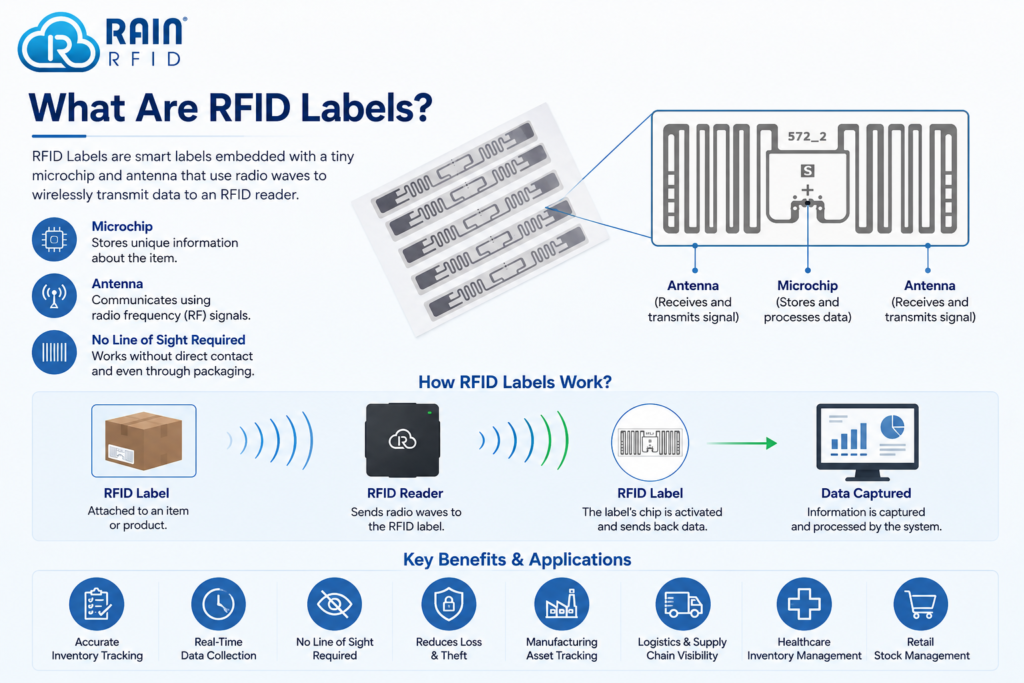
RFID tags are a type of tracking system that uses smart barcodes in order to identify items. RFID is short for “radio frequency identification,” and as such, RFID tags utilize radio frequency technology.
These radio waves transmit data from the tag to a reader, which then transmits the information to an RFID computer program. RFID tags are frequently used for merchandise, but they can also be used to track vehicles, pets, and even patients with Alzheimer’s disease.
An RFID tag may also be called an RFID chip.
How do RFID Tags Work?
An RFID tag works by transmitting and receiving information via an antenna and a microchip — also sometimes called an integrated circuit or IC. The microchip on an RFID reader is written with whatever information the user wants.
Types of RFID Tags
RFID tags are mainly divided into two categories: Active RFID tags and Passive RFID tags.
Active RFID tags come with an inbuilt battery that provides power to the tag. Because of this, they are also known as battery-powered RFID tags.
Passive RFID tags, on the other hand, do not have any battery. They receive power from the electromagnetic energy sent by an RFID reader. When the reader scans the tag, it sends energy to the tag, which activates the chip and antenna. The tag then sends its stored information back to the reader, and the reader forwards this data to an RFID software system for further processing.
Passive RFID tags generally operate on three major frequency ranges:
- Low Frequency (LF): 125–134 kHz
- High Frequency (HF): 13.56 MHz, also used in NFC technology
- Ultra High Frequency (UHF): 865–960 MHz
The working frequency plays an important role in deciding the reading range and performance of the RFID tag.
Passive RFID Tag Types
Passive RFID tags are commonly available in two major formats: RFID inlays and hard RFID tags.
RFID inlays are slim, lightweight, and flexible. They are usually designed to be attached to different surfaces or embedded into labels, cards, packaging, and other materials.
Hard RFID tags are built with a strong outer body, often made from durable plastic, metal, or other protective materials. These tags are suitable for tougher environments where extra strength and long-term usage are required.
Active RFID tags usually operate on frequencies such as 433 MHz or 915 MHz to communicate data. These tags generally include three important components:
- The RFID tag
- The antenna
- The RFID reader or interrogator
Active RFID tags have an internal battery that powers the tag and helps it transmit signals over a longer distance. In most cases, the battery life may last around 3 to 5 years, depending on usage and operating conditions. Once the battery stops working, the complete tag unit often needs to be replaced, as many active RFID tag batteries are not designed to be changed separately.
Active RFID Tag Types
Active RFID tags are mainly available in two types: beacon tags and transponder tags.
Beacon RFID tags continuously broadcast signals at regular time intervals. These signals can usually be detected from a long distance, depending on the system and environment. Since beacon tags transmit data frequently, they consume more battery power and may have a shorter battery life compared to other active RFID tags.
Transponder RFID tags work differently. They do not continuously send signals on their own. Instead, they become active when they come within the range of an RFID reader. The reader sends a signal to the transponder, and the transponder responds by sending back the required information.
Because transponder tags communicate only when triggered by a reader, they are generally more power-efficient and can offer better battery life than beacon-type active RFID tags.
What are RFID Tags Used for?
Active RFID tags are mainly available in two types: beacon tags and transponder tags.
Beacon RFID tags continuously broadcast signals at regular time intervals. These signals can usually be detected from a long distance, depending on the system and environment. Since beacon tags transmit data frequently, they consume more battery power and may have a shorter battery life compared to other active RFID tags.
Transponder RFID tags work differently. They do not continuously send signals on their own. Instead, they become active when they come within the range of an RFID reader. The reader sends a signal to the transponder, and the transponder responds by sending back the required information.
Because transponder tags communicate only when triggered by a reader, they are generally more power-efficient and can offer better battery life than beacon-type active RFID tags.
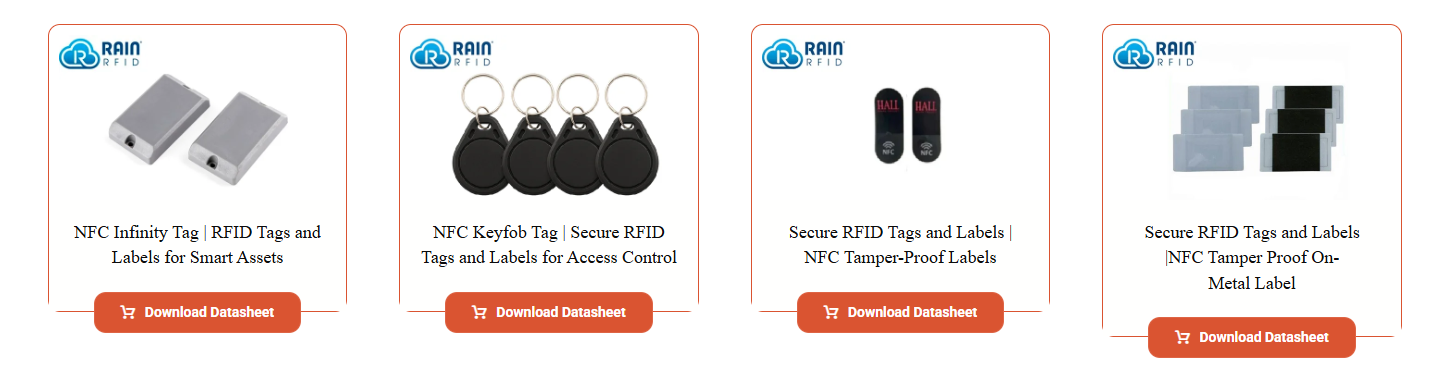
RFID tags used in a wide range of applications, including:
- Inventory management: RFID tags can be attached to products or packaging to track their location and movement throughout the supply chain.
- Access control: RFID tags can be used as electronic keys to grant access to secure areas or to track employee movements.
- Asset tracking with RFID: RFID tags can be used to track valuable assets, such as equipment, vehicles, or tools, to prevent theft or loss.
- Animal tracking: RFID tags can be used to track animals for research, wildlife management, or farming purposes.
- Payment systems: RFID tags can be used in contactless payment systems, such as transit fare payment cards or electronic toll collection.
- Healthcare: RFID tags can be used to track medical equipment, monitor patient vital signs, and ensure proper medication administration.
Overall, RFID technology enables automated data collection and can improve efficiency, accuracy, and security in a variety of industries and applications.
Examples of RFID Tags
RFID tags are used across many industries for tracking, identification, automation, and security. Depending on the application, businesses can choose between active RFID tags and passive RFID tags.
Active RFID tags are ideal for applications where real-time or long-range tracking is required. Since these tags have their own power source, they can continuously transmit signals and support live tracking solutions. This makes them useful for vehicle tracking, tolling systems, cargo monitoring, and other applications where instant visibility is important. Active RFID tags are generally more expensive, but they offer a longer read range and stronger performance in demanding environments.
Passive RFID tags are a cost-effective solution for businesses that need reliable identification and tracking at scale. These RFID tags are commonly used in supply chain management, inventory tracking, race timing, file management, access control, retail operations, and asset tracking. They are compact, lightweight, and do not require an internal battery, which helps reduce maintenance requirements.
Although passive RFID tags have a shorter read range compared to active RFID tags, they do not need direct line of sight with the RFID reader. This makes them more flexible than traditional barcode systems and suitable for many commercial and industrial uses.
Active RFID tags are usually larger and more rugged than passive RFID tags, making them suitable for harsh or outdoor environments. They are often used in toll payment systems, fleet and cargo tracking, industrial asset monitoring, and people-tracking applications where durability and long-distance readability are important.
RFGenie provides RFID tag solutions designed to support accurate tracking, efficient identification, and smarter business operations across multiple industries.
Advantages of Using RFID Tags
What are some of the main advantages of using RFID tags:
Increased efficiency: RFID tags can be read quickly and accurately, allowing for faster and more efficient tracking of items.
Improved accuracy: Unlike barcodes, RFID tags do not require a direct line of sight to be read, which means they can be read even when hidden or obscured.
Reduced labor costs: RFID tags can be read automatically, eliminating the need for manual scanning and reducing labor costs.
Enhanced security: RFID tags can be encrypted and programmed with unique identifiers, making it more difficult for counterfeit or unauthorized items to enter the supply chain.
Real-time tracking: RFID tags can provide real-time data on the location and movement of items, allowing for better inventory management and supply chain optimization.
Durability: RFID tags are typically more durable than barcodes, which can become damaged or unreadable over time.
Overall, the use of RFID tags can provide numerous benefits for businesses and organizations looking to improve their supply chain management and inventory tracking processes.
Disadvantages of RFID Tags
RFID tags offer fast and efficient tracking, but businesses should also understand their limitations. Security can be a concern because RFID data may be read by unauthorized readers if the system is not properly protected. Signal interference from metal, water, or nearby radio devices can also affect performance in some environments.
RFID implementation may require proper planning, hardware testing, reader placement, and system integration. This can make the initial setup more time-consuming compared to traditional barcode systems.
With the right RFID tags, readers, software, and expert guidance, these challenges can be reduced. RFGenie helps businesses choose suitable RFID solutions for accurate tracking, better visibility, and smoother inventory management.
Frequently Asked Questions
What is a RFID tag used for?
RFID tags are used for a variety of applications, including inventory management, tool tracking, asset tracking, equipment tracking, and more. Generally, they’re used to monitor an asset’s location or condition as it moves throughout an organization or the supply chain.
Can RFID tags be tracked?
Can RFID tags be hacked?
Yes, RFID tags can be hacked. They can be sensitive to radio interference, which can disrupt performance and readability.
Some RFID tags are rewriteable, and hackers can delete or replace the data. Sensitive data can also be intercepted by hackers if the data isn’t encrypted during transmission.
Can RFID tags track location?
Yes, RFID tags can track location, but to what extent depends on the type of RFID tag. Active RFID tags are battery-powered and can be detected within 300 feet of an RFID reader.
With some active tags, triangulation enables location tracking with +/- 10 foot accuracy. Passive tags, which rely on the radio signal transmitted by the RFID reader, which typically must be within about three to 16 feet of the RFID tags.


No comment