
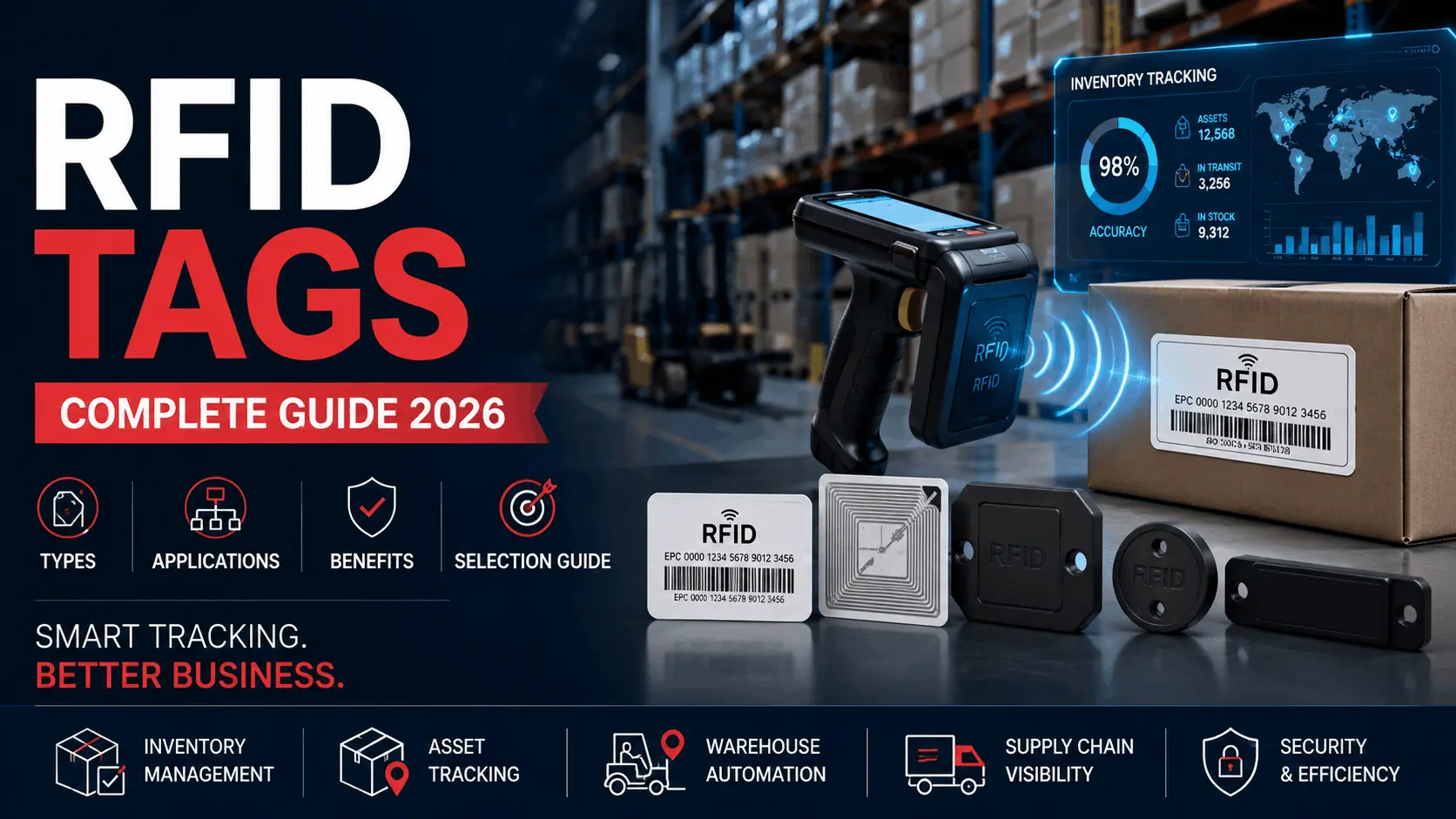
RFID Tags have become an essential part of modern inventory management, asset tracking, warehouse automation, and supply chain operations. Businesses across retail, healthcare, manufacturing, logistics, and government sectors use RFID technology to improve visibility and reduce manual work.
Unlike traditional barcode systems, RFID Tags allow organizations to identify and track assets without direct line-of-sight scanning. This capability helps businesses save time, improve accuracy, and increase operational efficiency.
In this guide, you will learn how RFID Tags work, their different types, applications, benefits, and how to choose the right RFID Tag for your business.
What Are RFID Tags?
RFID Tags are electronic devices that store and transmit data using radio frequency signals. These tags communicate with RFID Readers, allowing automatic identification and tracking of objects, products, pallets, equipment, and assets.
A typical RFID system includes:
- RFID Tag
- RFID Reader
- RFID Antenna
- RFID Software
When a tagged item enters the reader’s range, the system captures information instantly and sends it to the software platform.
How Do RFID Tags Work?
he working process of RFID Tags is simple and efficient.
Step 1: Data Storage
Each RFID Tag contains a microchip and antenna. The microchip stores a unique identification number or other information.
Step 2: Signal Transmission
An RFID Reader sends radio waves toward the RFID Tag.
Step 3: Tag Response
The RFID Tag receives the signal and transmits stored information back to the reader.
Step 4: Data Processing
The software processes the collected information and displays it for tracking, monitoring, or reporting purposes.
This automated process enables fast and accurate identification without manual scanning.
Types of RFID Tags
Different applications require different RFID Tags. Understanding the available options helps businesses choose the most suitable solution.
Passive RFID Tags
Passive RFID Tags do not contain an internal battery.
Benefits:
- Low cost
- Long lifespan
- Lightweight design
- Ideal for inventory
- management
Common Applications:
- Retail stores
- Warehouses
- Libraries
- Asset tracking
Active RFID Tags
Active RFID Tags include an internal battery.
Benefits:
- Long read range
- Real-time location tracking
- High-performance monitoring
Common Applications:
- Vehicle tracking
- Mining operations
- Industrial assets
- Logistics management
Semi-Passive RFID Tags
Semi-passive RFID Tags combine features of passive and active technologies.
Benefits:
- Better performance
- Extended functionality
- Enhanced sensor
- integration
Applications:
- Cold chain monitoring
- Industrial automation
- Environmental monitoring
Key Applications of RFID Tags
Inventory Management
RFID Tags help businesses maintain accurate inventory records and reduce stock discrepancies.
Asset Tracking
Organizations use RFID technology to monitor tools, equipment, and valuable assets.
Warehouse Automation
Warehouse operators improve receiving, picking, and shipping processes using RFID Tags.
Supply Chain Visibility
RFID systems provide real-time information throughout the supply chain.
Manufacturing
Manufacturers track raw materials, work-in-progress items, and finished products.
Healthcare
Hospitals use RFID Tags for equipment tracking, patient identification, and inventory control.
Retail Management
Retailers improve stock visibility and reduce out-of-stock situations.
Vehicle Tracking
Companies track fleet movement and optimize transportation operations.
RFID Tags vs Barcode Labels
Many businesses compare RFID Tags with barcode labels before implementing a tracking system.
| Feature | RFID Tags | Barcode Labels |
|---|---|---|
| Line of Sight Required | No | Yes |
| Multiple Item Reading | Yes | No |
| Read Speed | Fast | Moderate |
| Data Storage | High | Limited |
| Durability | High | Moderate |
| Automation Level | High | Low |
Conclusion: RFID Tags offer faster scanning, better automation, and real-time tracking compared to traditional barcode labels, making them ideal for inventory management, asset tracking, warehouse automation, and supply chain visibility.
Benefits of RFID Tags
Organizations invest in RFID technology because it delivers measurable benefits.
Improved Accuracy
RFID systems reduce manual data entry errors.
Faster Operations
Employees complete inventory counts and asset verification much faster.
Better Visibility
Businesses gain real-time insights into inventory and asset locations.
Reduced Labor Costs
Automation minimizes repetitive manual tasks.
Enhanced Security
RFID Tags help prevent theft, loss, and unauthorized movement of assets.
Increased Productivity
Teams spend less time searching for products and equipment.
How to Choose the Right RFID Tag
Selecting the right RFID Tag depends on several factors.
Consider:
Surface Material
Metal, plastic, wood, and glass require different tag designs.
Read Range
Choose a tag that meets operational distance requirements.
Environment
Temperature, moisture, dust, and chemicals can affect performance.
Mounting Method
RFID Tags can be adhesive, screw-mounted, embedded, or cable-tied.
Frequency Type
Select LF, HF, or UHF based on the application.
Industry Requirements
Healthcare, manufacturing, retail, and logistics sectors often require specialized RFID solutions.
Common Mistakes When Choosing RFID Tags
Many businesses face performance issues because of incorrect tag selection.
Avoid these mistakes:
Ignoring environmental conditions
Choosing the wrong frequency
Using standard tags on metal surfaces
Overlooking read range requirements
Selecting tags without testing
Proper testing ensures reliable RFID system performance.
Future of RFID Tags in 2026
RFID technology continues to evolve rapidly.
Key trends include:
- AI-powered inventory management
- Smart warehouses
- Digital supply chains
- Real-time asset intelligence
- Industry 4.0 integration
- Advanced IoT connectivity
Businesses that adopt RFID technology today position themselves for greater efficiency and long-term growth.
Why Choose RF Genie for RFID Tags?
RF Genie provides high-quality RFID Tags and RFID Labels designed for diverse industrial applications.
Our solutions support:
- Inventory Management
- Asset Tracking
- Warehouse Automation
- Retail Operations
- Manufacturing Processes
- Supply Chain Management
We offer customized RFID solutions that help organizations improve visibility, accuracy, and operational efficiency.
Conclusion
RFID Tags have transformed the way businesses manage inventory, assets, and supply chain operations. Whether you need passive RFID Tags, active RFID Tags, or UHF RFID Tags, selecting the right solution can significantly improve efficiency and accuracy.
As RFID adoption continues to grow, businesses that implement the right RFID technology will gain a competitive advantage through automation, real-time visibility, and smarter decision-making.
FAQ
RFID Tags are used for inventory management, asset tracking, warehouse automation, retail management, healthcare, and logistics applications.
RFID Tags do not require line-of-sight scanning and can read multiple items simultaneously, while barcodes require direct scanning.
UHF RFID Tags are commonly used for inventory management because they offer longer read ranges and fast scanning capabilities.
Passive RFID Tags can last more than 10 years, depending on environmental conditions and usage.
Yes. Special On-Metal RFID Tags are designed specifically for metal assets and industrial environments.


No comment