
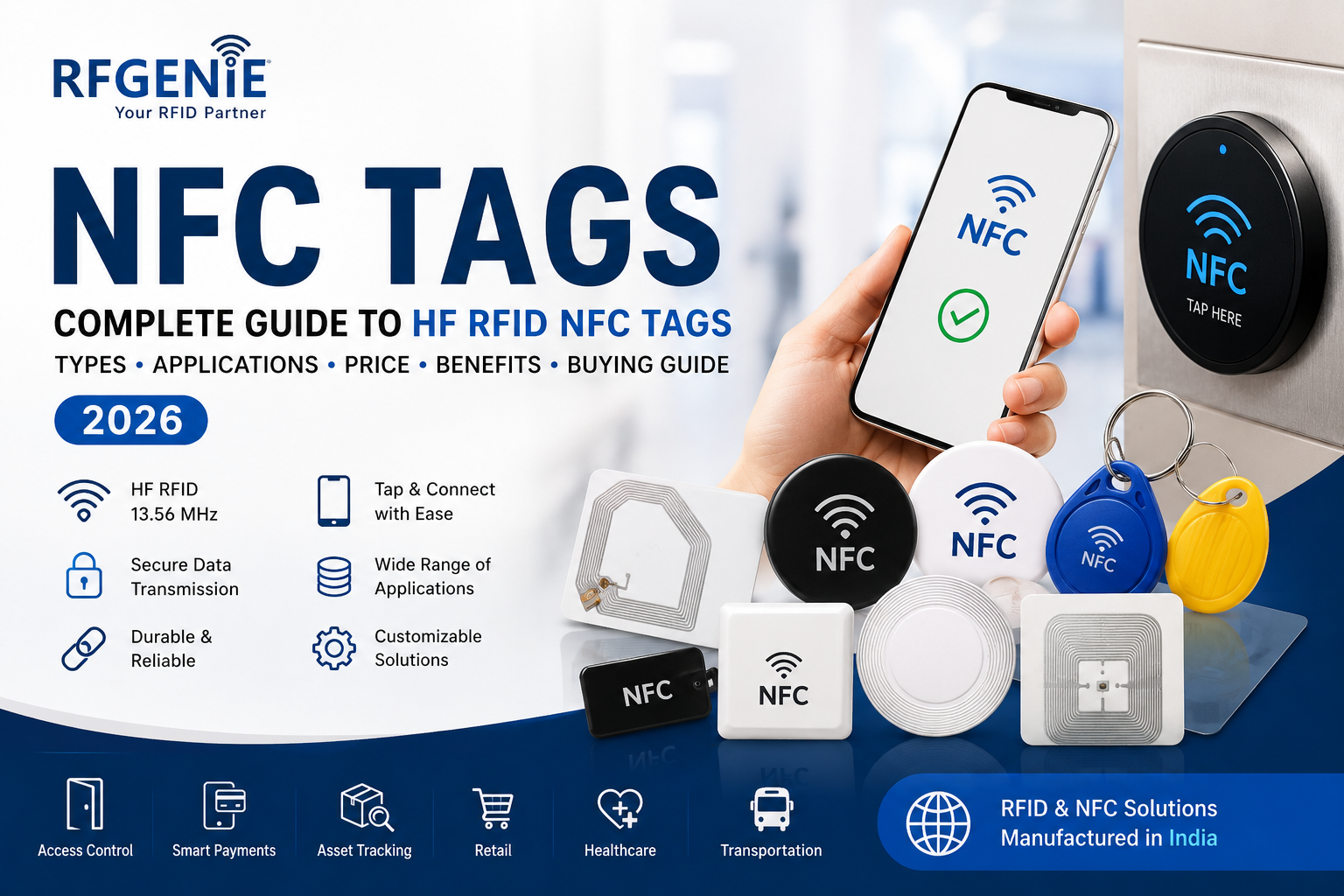
In today’s fast-paced digital world, NFC Tags have become an essential technology for businesses looking to improve automation, product authentication, customer engagement, and asset tracking. Operating on 13.56 MHz High Frequency (HF RFID) technology, NFC Tags enable secure, contactless communication between NFC-enabled devices such as smartphones, tablets, and NFC readers. From retail stores and manufacturing plants to healthcare, logistics, smart packaging, and access control systems, NFC Tags are transforming the way organizations connect physical products with digital information.
Whether you are searching for NFC Tags, comparing NFC Tags price, or looking for a trusted NFC Tags manufacturer in India, choosing the right solution is essential for long-term performance and reliability. High-quality NFC Tags offer fast data transfer, excellent durability, customizable designs, and compatibility with international NFC standards, making them suitable for a wide range of industrial and commercial applications.
At RFGenie, we manufacture premium-quality HF RFID NFC Tags designed to meet the diverse requirements of businesses across multiple industries. Our NFC Tags are available in various sizes, chip options, adhesive types, and form factors, ensuring seamless integration into inventory management, asset tracking, product authentication, smart packaging, and digital marketing solutions.
In this comprehensive guide, you’ll learn everything about NFC Tags, including how they work, different types of NFC Tags, key features, industrial applications, benefits, NFC Tags price factors, and practical tips for choosing the right NFC solution for your business.
Why Read This Guide?
By the end of this article, you’ll understand:
- What are NFC Tags?
- How NFC Tags work
- Components of an NFC Tag
- Types of NFC Tags and HF RFID Tags
- Features and benefits of NFC technology
- Industries using NFC Tags
- NFC Tags price factors
- How to choose the right NFC Tag
- Why RFGenie is a trusted NFC Tags manufacturer in India
What are NFC Tags? NFC Tags are passive High Frequency (HF RFID) tags that operate at 13.56 MHz and enable contactless communication with NFC-enabled smartphones and readers. They are widely used for asset tracking, inventory management, product authentication, access control, smart packaging, and customer engagement across various industries.
What Are NFC Tags?
NFC Tags (Near Field Communication Tags) are small, passive wireless devices that use High Frequency (HF RFID) technology operating at 13.56 MHz. They store digital information and enable secure, contactless communication with NFC-enabled smartphones, tablets, payment terminals, and dedicated NFC readers. Unlike QR codes, NFC Tags do not require a camera or direct line of sight—users simply tap or bring an NFC-enabled device close to the tag to access the stored information instantly.
NFC Tags consist of a tiny NFC chip (integrated circuit), a copper or aluminum antenna, and a protective substrate or label material. Because they are passive devices, they do not contain a battery. Instead, they draw the small amount of energy required for communication from the electromagnetic field generated by an NFC-enabled device or reader. This makes NFC Tags maintenance-free, durable, and suitable for long-term industrial and commercial use.
As a subset of HF RFID (High Frequency Radio Frequency Identification) technology, NFC Tags follow internationally recognized standards such as ISO/IEC 14443, ISO/IEC 15693 (depending on the tag type), and NFC Forum specifications. These standards ensure compatibility between tags and devices from different manufacturers, enabling reliable communication across multiple applications.
Modern smartphones support NFC technology, allowing users to interact with NFC Tags without installing specialized hardware. Depending on the programmed data, a single tap can:
- Open a website or product page
- Display product information
- Verify product authenticity
- Share contact details
- Launch an application
- Connect to Wi-Fi
- Trigger business automation
- Record maintenance history
- Track assets and inventory
This convenience has made NFC Tags one of the most versatile identification and engagement technologies available today.
How NFC Tags Store Information
Each NFC Tag contains a small memory chip that can store different types of digital information. The storage capacity varies depending on the chip model, such as NTAG213, NTAG215, or NTAG216.
Typical information stored on an NFC Tag includes:
- Website URLs
- Product serial numbers
- Asset IDs
- Employee information
- Digital business cards
- Contact details (vCard)
- Wi-Fi credentials
- Equipment maintenance records
- Product authentication data
- Marketing campaign links
Depending on the application, NFC Tags can be configured as Read Only (data cannot be changed) or Read/Write (information can be updated when required). Many NFC chips also support password protection and memory locking for enhanced security.
Why Are NFC Tags Becoming Popular?
Businesses across industries are rapidly adopting NFC Tags because they bridge the gap between physical products and digital experiences. A simple tap can provide customers, employees, or service technicians with instant access to relevant information, reducing manual effort and improving operational efficiency.
Compared to traditional barcode systems, NFC Tags offer several advantages:
- No line-of-sight scanning required
- Fast and contactless data transfer
- Rewritable memory (depending on chip type)
- Better security features
- Works with most NFC-enabled smartphones
- Long service life without batteries
- Resistant to wear and environmental conditions
- Easy integration with existing business systems
These advantages make NFC Tags an ideal solution for industries that require accurate identification, automation, and real-time information access.
Why Businesses Choose RFGenie NFC Tags
At RFGenie, we manufacture high-quality HF RFID NFC Tags designed for demanding industrial and commercial environments. Our NFC Tags are available in multiple chip options, sizes, materials, and adhesive configurations to meet the requirements of retail, manufacturing, logistics, healthcare, smart packaging, and asset tracking applications.
Whether you need standard NFC labels or fully customized NFC solutions, our team helps businesses select the right tag based on read range, memory, surface type, durability, and environmental conditions.
How Do NFC Tags Work?
NFC Tags work using Near Field Communication (NFC), a short-range wireless communication technology based on High Frequency (HF RFID) operating at 13.56 MHz. NFC enables secure, contactless data exchange between an NFC Tag and an NFC-enabled device, such as a smartphone, tablet, payment terminal, or dedicated NFC reader.
Unlike Bluetooth or Wi-Fi, NFC does not require pairing or an internet connection. Communication starts automatically when an NFC-enabled device comes within approximately 2–5 cm of the tag, making it one of the fastest and most convenient contactless technologies available today.
Since NFC Tags are passive devices, they do not contain a battery or external power source. Instead, they receive the energy needed for communication from the electromagnetic field generated by the NFC reader or smartphone.
The NFC Communication Process
The communication between an NFC Tag and an NFC-enabled device happens in just a fraction of a second through electromagnetic induction.
Step 1: The NFC Reader Generates a Magnetic Field
When NFC is enabled on a smartphone or an NFC reader, the device continuously emits a small electromagnetic field at 13.56 MHz.
This field acts as the power source for nearby passive NFC Tags.
Step 2: The NFC Tag Receives Power
As soon as the NFC Tag enters the magnetic field, its embedded antenna captures the energy and transfers it to the NFC chip.
Because NFC Tags are passive, they only become active while inside the reader’s magnetic field.
No battery is required.
Step 3: The NFC Chip Responds
Once powered, the chip instantly sends its stored information back to the reader.
The transmitted data may include:
- Product Information
- Website URL
- Product Authentication Data
- Digital Business Card
- Asset ID
- Inventory Number
- Wi-Fi Credentials
- Contact Details
- Maintenance Records
- Marketing Campaign Links
The entire communication process usually completes in less than one second.
Step 4: The Reader Processes the Data
The smartphone or NFC reader decodes the received information and performs the programmed action.
Examples include:
- Opening a product webpage
- Displaying product specifications
- Verifying product authenticity
- Registering equipment inspection
- Recording maintenance activity
- Opening a mobile application
- Connecting to Wi-Fi
- Launching a digital brochure
This seamless interaction eliminates manual data entry and enhances the overall user experience.
Components Involved in NFC Communication
An NFC system consists of four essential components that work together to enable reliable data exchange.
1. NFC Chip
The NFC chip stores the digital information that will be transmitted when the tag is scanned.
Popular chip options include:
- NTAG213
- NTAG215
- NTAG216
- MIFARE Ultralight
- MIFARE Classic
- ICODE SLIX
The available memory depends on the chip type and application requirements.
2. NFC Antenna
The antenna receives energy from the NFC reader and transmits data back through radio frequency signals.
Its design significantly influences:
- Read performance
- Reading stability
- Communication speed
- Reliability
3. NFC Reader
The reader generates the electromagnetic field and receives the response from the NFC Tag.
Examples include:
- Android Smartphones
- NFC-enabled iPhones
- Industrial RFID Readers
- POS Systems
- Access Control Readers
- Attendance Machines
4. Software Platform
After reading the tag, software processes the information and performs the desired action.
Examples include:
- Inventory Management Software
- Warehouse Management System (WMS)
- ERP Systems
- CRM Platforms
- Manufacturing Execution Systems (MES)
- Mobile Applications
- Asset Management Software
Passive vs Active NFC Tags
| Feature | Passive NFC Tags | Active NFC Devices |
|---|---|---|
| Battery | No | Yes |
| Power Source | Reader Field | Internal Battery |
| Maintenance | Minimal | Requires Battery Replacement |
| Cost | Lower | Higher |
| Lifespan | Long | Depends on Battery |
| Common Use | Labels, Stickers, Cards | Specialized Industrial Systems |
Components of NFC Tags
Although an NFC Tag looks like a simple sticker, card, or label, it is built using several precision-engineered components that work together to enable reliable contactless communication. The performance, durability, read speed, memory capacity, and compatibility of an NFC Tag depend on the quality of these components.
A standard HF RFID NFC Tag consists of four main parts:
- NFC Chip (Integrated Circuit)
- NFC Antenna
- Substrate or Base Material
- Protective Layer (Face Material & Adhesive)
Understanding these components helps businesses choose the right NFC Tag for applications such as asset tracking, inventory management, smart packaging, retail labeling, healthcare, and industrial automation.
1. NFC Chip (Integrated Circuit)
The NFC chip is the brain of the NFC Tag. It stores digital information and controls communication with NFC-enabled devices. Every time a smartphone or NFC reader scans the tag, the chip securely transmits the stored data.
Depending on the application, an NFC chip can store:
- Website URLs
- Product IDs
- Serial Numbers
- Digital Business Cards
- Contact Information
- Product Authentication Data
- Wi-Fi Credentials
- Asset Information
- Maintenance Records
- Customer Engagement Links
Many NFC chips also support advanced security features such as:
- Password Protection
- Read/Write Lock
- Unique Identifier (UID)
- Digital Signature
- Data Authentication
The chip you choose directly affects memory capacity, security, compatibility, and overall performance.
Popular NFC Chip Types
Different applications require different memory capacities. Below are some of the most widely used NFC chips.
| NFC Chip | User Memory | Best For |
|---|---|---|
| NTAG213 | 144 Bytes | Business cards, URLs, smart posters, product labels |
| NTAG215 | 504 Bytes | Loyalty cards, authentication, marketing campaigns |
| NTAG216 | 888 Bytes | Large data storage, industrial applications, asset management |
| MIFARE Ultralight | Low Memory | Ticketing and public transport |
| MIFARE Classic | Medium Memory | Access control and employee ID cards |
| ICODE SLIX | Industrial HF RFID | Libraries, archives, document tracking |
NTAG213 vs NTAG215 vs NTAG216
Selecting the right chip depends on how much information you need to store.
| Feature | NTAG213 | NTAG215 | NTAG216 |
|---|---|---|---|
| Memory | 144 Bytes | 504 Bytes | 888 Bytes |
| Read Speed | Fast | Fast | Fast |
| Smartphone Compatibility | Yes | Yes | Yes |
| Password Protection | Yes | Yes | Yes |
| Typical Applications | URLs, QR replacement | Marketing & Authentication | Industrial Data & Asset Tracking |
Recommendation:
- NTAG213 – Best for websites, product pages, and digital business cards.
- NTAG215 – Suitable for marketing campaigns, loyalty programs, and secure authentication.
- NTAG216 – Recommended for industrial applications, equipment management, and detailed asset records.
2. NFC Antenna
The antenna is responsible for receiving energy from the NFC reader and transmitting data stored in the chip.
It is typically made from:
- Copper
- Aluminum
- Silver Conductive Ink
The antenna design has a significant impact on:
- Read Range
- Signal Strength
- Reading Speed
- Communication Stability
- Reliability
A professionally designed antenna ensures fast and accurate communication even in demanding industrial environments.
3. Substrate (Base Material)
The substrate forms the structural foundation of the NFC Tag. It supports the chip and antenna while providing mechanical strength and flexibility.
Common substrate materials include:
- PET (Polyester)
- PVC
- Paper
- Polypropylene (PP)
- Flexible Film
- Specialty Industrial Materials
The choice of substrate depends on:
- Indoor or outdoor use
- Exposure to moisture
- Temperature conditions
- Flexibility requirements
- Surface type
Industrial environments often require durable PET or specialized synthetic materials for long-lasting performance.
4. Protective Layer & Adhesive
The protective layer shields the NFC Tag from environmental factors such as dust, moisture, scratches, chemicals, and abrasion. The adhesive ensures secure attachment to different surfaces.
Depending on the application, NFC Tags can be supplied with:
- Permanent Adhesive
- High-Tack Adhesive
- Removable Adhesive
- Tamper-Evident Adhesive
- On-Metal Adhesive
- Waterproof Lamination
- UV-Resistant Coating
Choosing the correct face material and adhesive improves durability and ensures reliable operation throughout the tag’s service life.
Why RFGenie NFC Tags Deliver Reliable Performance
At RFGenie, every NFC Tag is engineered using high-quality chips, precision antennas, durable substrates, and application-specific adhesives. Our solutions are designed for industries including retail, manufacturing, logistics, healthcare, education, smart packaging, and asset management.
We offer:
- Custom chip selection (NTAG213, NTAG215, NTAG216 & more)
- Multiple tag sizes and shapes
- Printable NFC labels
- Waterproof and industrial-grade options
- On-metal NFC Tags
- Custom branding and encoding
- Bulk manufacturing with strict quality control
Whether you need NFC Tags for inventory management, product authentication, customer engagement, or industrial automation, RFGenie provides solutions tailored to your business requirements.
NFC Tags vs RFID Tags vs QR Codes
Businesses often compare NFC Tags, RFID Tags, and QR Codes when selecting the right identification or tracking technology. While all three help connect physical products with digital information, they differ significantly in terms of communication method, read range, security, speed, and business applications.
Understanding these differences will help you choose the best technology based on your operational requirements, budget, and customer experience goals.
What is the Difference Between NFC Tags and RFID Tags?
NFC (Near Field Communication) is a specialized subset of HF RFID (High Frequency RFID) technology. Every NFC Tag is an HF RFID Tag operating at 13.56 MHz, but not every RFID Tag supports NFC communication with smartphones.
NFC Tags are designed for short-range, secure communication with smartphones and NFC readers, while RFID technology includes Low Frequency (LF), High Frequency (HF), and Ultra High Frequency (UHF) solutions for various industrial applications.
NFC Tags
Best for:
- Product Authentication
- Smart Packaging
- Digital Business Cards
- Customer Engagement
- Marketing Campaigns
- Access Control
- Mobile Interaction
Typical Read Range
2–5 cm
RFID Tags
Best for:
- Warehouse Management
- Inventory Tracking
- Asset Tracking
- Logistics
- Manufacturing
- Supply Chain Automation
Typical Read Range
- HF RFID: Up to 10 cm
- UHF RFID: Up to 10 meters (depending on hardware and environment)
NFC Tags vs QR Codes
QR Codes are widely used because they are inexpensive and easy to print. However, they require a smartphone camera and a direct line of sight for scanning.
NFC Tags provide a more seamless user experience. Users simply tap their smartphone against the tag without opening a camera or aligning the code.
QR Codes
Advantages
- Very low cost
- Easy to print
- Works on most smartphones
- Suitable for static information
Limitations
- Requires camera scanning
- Can become damaged or dirty
- Easy to copy or duplicate
- Lower security
- Slower user interaction
NFC Tags
Advantages
- Instant tap-to-connect
- No camera required
- More secure than QR Codes
- Password protection available
- Better customer experience
- Rewritable memory
- Supports product authentication
Limitations
- Higher initial cost than QR Codes
- Requires NFC-enabled devices (supported by most modern smartphones)
Features of NFC Tags
NFC Tags have become one of the most reliable contactless identification technologies for modern businesses. Built on 13.56 MHz High Frequency (HF RFID) technology, they offer fast communication, enhanced security, smartphone compatibility, and seamless integration with business systems. Whether used for inventory management, product authentication, smart packaging, or customer engagement, NFC Tags provide a powerful combination of convenience and performance.
Below are the key features that make NFC Tags an ideal solution across various industries.
1. Contactless Communication
One of the biggest advantages of NFC Tags is their ability to communicate wirelessly without physical contact. Users simply tap an NFC-enabled smartphone or reader near the tag to access stored information instantly.
Benefits:
- No physical contact required
- Instant tap-to-read functionality
- Improved user experience
- Faster business operations
2. Operates at 13.56 MHz (HF RFID Technology)
NFC Tags work on High Frequency (HF RFID) technology at 13.56 MHz, ensuring stable, secure, and standardized communication.
This frequency is globally recognized and supported by international NFC standards, making NFC Tags compatible with millions of devices worldwide.
3. Smartphone Compatibility
Most modern Android smartphones and Apple iPhones support NFC technology, allowing users to interact with NFC Tags without additional hardware.
This makes NFC Tags ideal for:
- Smart Packaging
- Digital Business Cards
- Product Authentication
- Customer Engagement
- Mobile Marketing
4. Battery-Free Operation
NFC Tags are passive devices and do not require a battery or external power source. They draw energy from the electromagnetic field generated by an NFC-enabled smartphone or reader.
Advantages:
- Maintenance-free
- Long service life
- Lightweight design
- Cost-effective deployment
5. Fast Data Transfer
NFC Tags exchange information within milliseconds, providing a smooth and efficient user experience.
Users can instantly:
- Open a website
- View product information
- Access digital documents
- Verify product authenticity
- Register warranties
- Connect to Wi-Fi
6. Rewritable Memory
Many NFC Tags allow stored information to be updated multiple times, making them suitable for dynamic business applications.
Common rewritable use cases include:
- Asset Tracking
- Equipment Maintenance
- Inventory Updates
- Event Management
- Loyalty Programs
7. High Security
Modern NFC chips offer advanced security features that help protect sensitive data and prevent unauthorized access.
Security features may include:
- Password Protection
- Read/Write Lock
- Unique Chip ID (UID)
- Digital Signature
- Authentication Support
These features make NFC Tags suitable for access control, product authentication, and secure business applications.
8. Durable and Long-Lasting
NFC Tags are available in materials designed to withstand different environmental conditions.
Depending on the application, they can be:
- Waterproof
- Dustproof
- UV Resistant
- Chemical Resistant
- Scratch Resistant
- Heat Resistant
Industrial-grade NFC Tags are specifically designed for demanding environments such as manufacturing plants, warehouses, and outdoor installations.
9. Customizable Design
NFC Tags can be fully customized to match your branding and technical requirements.
Customization options include:
- Custom Shapes
- Custom Sizes
- Company Logo Printing
- Barcode Printing
- QR Code Printing
- Variable Data Printing
- UID Encoding
- Chip Programming
- Color Printing
This flexibility makes NFC Tags suitable for retail, healthcare, manufacturing, logistics, hospitality, and promotional campaigns.
10. Multiple Form Factors
NFC technology is available in various formats to suit different applications.
Popular options include:
- NFC Sticker Labels
- NFC Cards
- NFC Key Fobs
- NFC Wristbands
- On-Metal NFC Tags
- Epoxy NFC Tags
- NFC Hang Tags
- Industrial NFC Tags
Each form factor is designed to meet specific business and environmental requirements.
11. Easy Integration with Business Systems
NFC Tags integrate seamlessly with modern software platforms, enabling automation and real-time data access.
They can be connected with:
- ERP Systems
- Warehouse Management Systems (WMS)
- Inventory Management Software
- CRM Platforms
- Manufacturing Execution Systems (MES)
- Asset Management Solutions
- Mobile Applications
This integration improves operational efficiency and reduces manual errors.
12. Wide Range of Business Applications
NFC Tags support a broad range of commercial and industrial applications, including:
- Inventory Management
- Asset Tracking
- Product Authentication
- Smart Packaging
- Retail Automation
- Healthcare Identification
- Digital Marketing
- Access Control
- Equipment Maintenance
- Customer Engagement
Their versatility makes them a valuable investment for businesses across multiple sectors.
Key Features at a Glance
| Feature | Benefit |
|---|---|
| Contactless Communication | Quick and convenient interaction |
| 13.56 MHz HF RFID | Global compatibility |
| Smartphone Compatible | Works with most modern phones |
| Battery-Free | Maintenance-free operation |
| Fast Data Transfer | Instant information access |
| Rewritable Memory | Flexible for changing data |
| Advanced Security | Password protection & authentication |
| Durable Construction | Suitable for harsh environments |
| Customizable | Branding and application-specific design |
| Easy System Integration | Connects with ERP, WMS, CRM, and more |
Why RFGenie NFC Tags?
At RFGenie, we manufacture premium-quality HF RFID NFC Tags using industry-leading chips and durable materials. Our tags are designed for high performance, long service life, and seamless compatibility with smartphones and industrial NFC readers.
We offer:
- Standard & Custom NFC Tags
- NTAG213, NTAG215 & NTAG216 Options
- Custom Printing & Encoding
- Waterproof & On-Metal Solutions
- Industrial-Grade Tags
- Bulk Manufacturing
- PAN India & Global Supply
Whether you need NFC Tags for retail, manufacturing, logistics, healthcare, or smart packaging, RFGenie delivers reliable and scalable NFC solutions tailored to your business needs.
Applications of NFC Tags
The versatility of NFC Tags makes them one of the most widely adopted contactless technologies across industries. From retail stores and manufacturing plants to healthcare facilities and smart packaging, NFC Tags simplify data sharing, automate processes, improve customer engagement, and enhance operational efficiency.
By enabling instant communication between physical products and digital systems, NFC Tags help businesses reduce manual work, improve accuracy, and deliver a better user experience.
Below are some of the most common applications of NFC Tags.
1. Asset Tracking
NFC Tags provide every asset with a unique digital identity, making it easier to monitor equipment throughout its lifecycle.
Common Assets
- Laptops
- Computers
- Industrial Machines
- Office Equipment
- Laboratory Instruments
- Medical Devices
- Manufacturing Tools
Benefits
- Faster asset identification
- Maintenance history
- Reduced asset loss
- Improved audit accuracy
2. Inventory Management
NFC Tags simplify inventory management by enabling quick identification and real-time updates.
Businesses can monitor stock movement, reduce manual errors, and improve warehouse efficiency.
Suitable For
- Warehouses
- Retail Stores
- Manufacturing Plants
- Distribution Centers
Benefits
- Accurate inventory records
- Faster stock verification
- Reduced human error
- Improved inventory visibility
3. Product Authentication
Counterfeit products are a growing concern across industries. NFC Tags help verify product authenticity with a simple smartphone tap.
Customers can instantly:
- Verify genuine products
- Check manufacturing details
- View warranty information
- Register products
- Access user manuals
This improves customer trust and protects brand reputation.
4. Smart Packaging
Smart Packaging combines traditional packaging with NFC technology to create interactive customer experiences.
By tapping an NFC-enabled smartphone, customers can access:
- Product Information
- Ingredients
- User Guides
- Videos
- Warranty Registration
- Promotional Offers
- Sustainability Information
Industries using Smart Packaging include:
- Cosmetics
- Food & Beverage
- Electronics
- Pharmaceuticals
- Luxury Goods
5. Retail Solutions
Retail businesses use NFC Tags to improve shopping experiences and enhance customer engagement.
Applications include:
- Smart Product Labels
- Digital Price Information
- Loyalty Programs
- Personalized Promotions
- Interactive Displays
- Customer Feedback
Benefits include increased customer engagement and faster access to product information.
6. Digital Business Cards
Traditional business cards are increasingly being replaced by NFC-enabled digital business cards.
With a simple tap, users can instantly share:
- Contact Details
- Company Information
- Website
- Social Media Profiles
- Portfolio
This eliminates the need for printed cards and makes networking more efficient.
7. Access Control
NFC Tags are widely used for secure access management in offices, hotels, educational institutions, and residential complexes.
Applications include:
- Employee Access Cards
- Hotel Room Keys
- Visitor Management
- Student Identification
- Parking Access
Benefits:
- Secure authentication
- Quick access
- Improved security
- Better visitor management
8. Healthcare
Hospitals and healthcare providers use NFC Tags to improve patient safety and equipment management.
Common applications include:
- Patient Identification
- Medical Equipment Tracking
- Laboratory Sample Identification
- Medication Management
- Maintenance Records
Benefits include improved accuracy and reduced administrative workload.
9. Manufacturing
Manufacturing companies use NFC Tags to monitor production processes and improve equipment management.
Applications include:
- Machine Identification
- Preventive Maintenance
- Work Order Tracking
- Production Monitoring
- Quality Control
- Tool Management
NFC technology supports Industry 4.0 initiatives by connecting physical assets with digital systems.
10. Logistics & Supply Chain
NFC Tags improve visibility throughout the supply chain by enabling accurate tracking of products and shipments.
Applications include:
- Shipment Verification
- Warehouse Operations
- Package Identification
- Delivery Confirmation
- Return Management
Benefits:
- Better shipment accuracy
- Faster processing
- Reduced losses
- Improved traceability
11. Hospitality & Events
Hotels, resorts, event organizers, and entertainment venues use NFC Tags to deliver seamless guest experiences.
Applications include:
- Hotel Check-in
- Digital Room Keys
- Event Ticketing
- Cashless Payments
- Guest Identification
- Membership Programs
12. Marketing & Customer Engagement
NFC Tags create interactive marketing campaigns that encourage customer engagement.
Businesses can use NFC Tags to:
- Launch promotional offers
- Collect customer feedback
- Share product videos
- Link to social media
- Offer discount coupons
- Drive website traffic
This bridges the gap between offline products and digital experiences.
Popular Applications of NFC Tags
| Application | Primary Benefit |
|---|---|
| Asset Tracking | Real-time asset identification |
| Inventory Management | Improved stock accuracy |
| Product Authentication | Anti-counterfeit protection |
| Smart Packaging | Interactive customer experience |
| Retail | Enhanced shopping experience |
| Digital Business Cards | Instant contact sharing |
| Access Control | Secure entry management |
| Healthcare | Better patient & equipment tracking |
| Manufacturing | Production and maintenance monitoring |
| Logistics | Supply chain visibility |
| Hospitality | Seamless guest management |
| Marketing | Increased customer engagement |
Why Businesses Choose RFGenie NFC Tags
At RFGenie, we manufacture application-specific HF RFID NFC Tags designed to meet the needs of modern businesses. Whether you require NFC Tags for inventory management, smart packaging, access control, asset tracking, or customer engagement, we provide reliable and customizable solutions built for long-term performance.
Our NFC Tags are available in multiple chip options, materials, sizes, and form factors to support industries including retail, manufacturing, logistics, healthcare, hospitality, and education.
)
No comment