
NFC Tags: Complete Guide to Types, Uses, Working & Manufacturing
NFC tags are transforming the way physical products, packaging, cards, labels, and marketing materials connect with the digital world. These compact, battery-free devices can store digital information and communicate with an NFC-enabled smartphone or reader when brought within close proximity.
From smart packaging and product authentication to contactless interactions, digital menus, access control, and information sharing, NFC tags offer a simple way to add digital functionality to everyday objects.
In this complete guide, we will explore what NFC tags are, how they work, different types of NFC tags, their applications, benefits, and NFC tag manufacturing.
What Are NFC Tags?
An NFC tag is a small electronic device designed for short-range wireless communication. It generally consists of an NFC integrated circuit (IC), memory, and an antenna.
Unlike many electronic devices, NFC tags usually do not require a built-in battery. When an NFC-enabled smartphone or reader comes close to the tag, the electromagnetic field generated by the reader can provide the energy needed for the tag to operate and exchange information.
Depending on how they are programmed, NFC tags can store or provide access to information such as:
- Website URLs
- Contact information
- Product details
- Digital menus
- Authentication information
- Social media profiles
- Promotional content
- Digital documents
- Wi-Fi connection information
- Product identification data
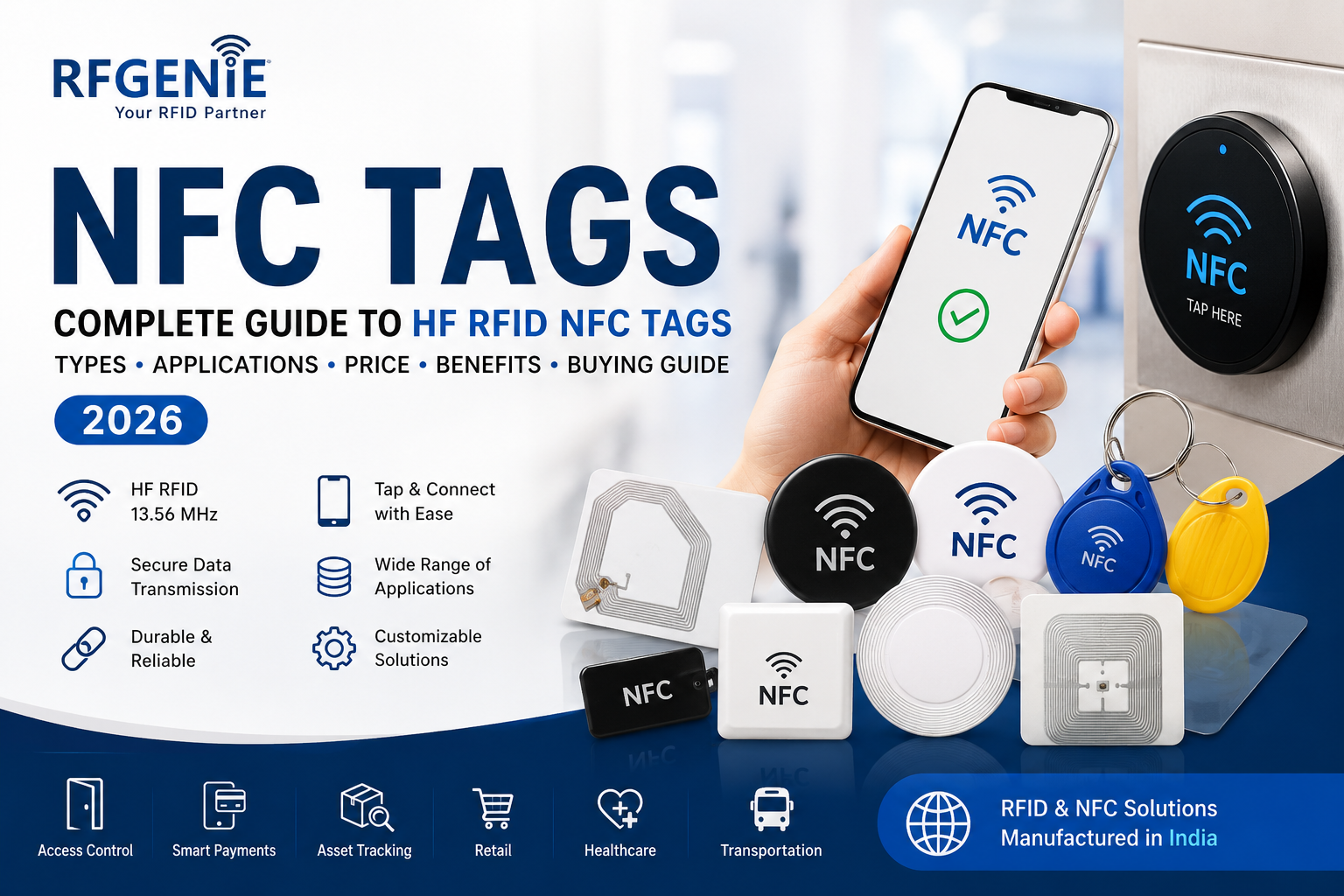
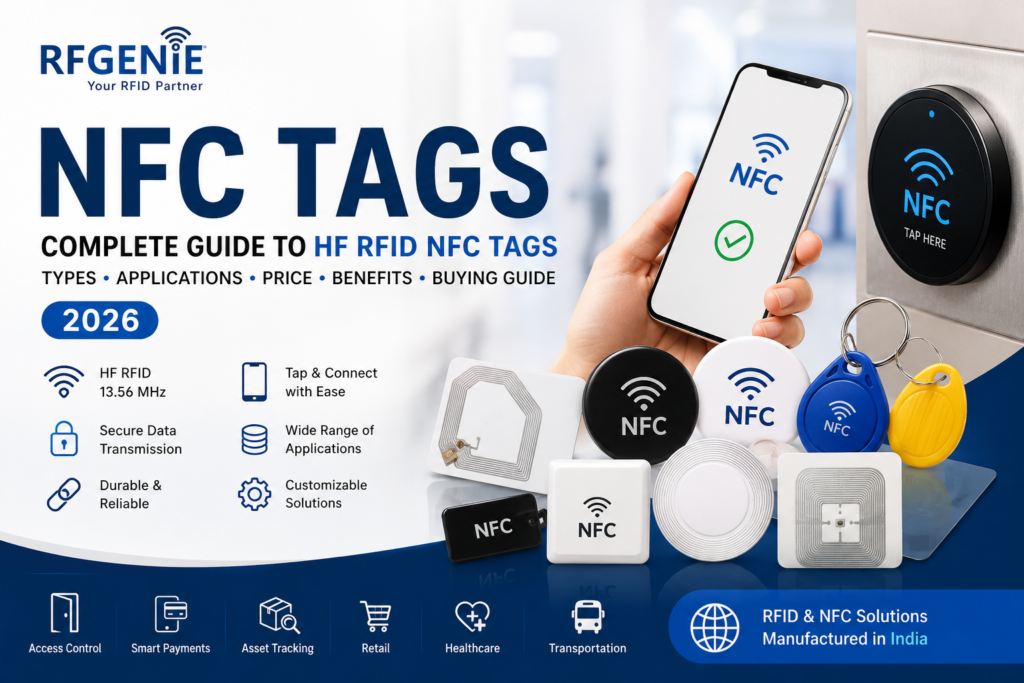
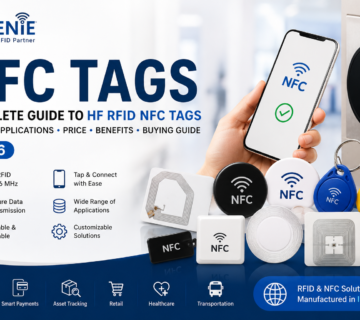
NFC tags are available in several formats, including stickers, labels, cards, key fobs, and customized product tags
How NFC Tags Work Without a Battery
One of the most useful characteristics of NFC tags is their battery-free operation.
Passive NFC tags receive the energy required for communication from the nearby NFC reader. This eliminates the need for a separate battery in many common NFC tag applications.
This battery-free design makes NFC tags:
- Compact
- Lightweight
- Easy to integrate
- Low maintenance
- Suitable for labels and packaging
- Practical for large-scale deployment
Because there is no battery to replace, NFC tags can be incorporated into products and printed materials where maintaining a power source would be impractical.
Types of NFC Tags
NFC tags are generally categorized into five main types: Type 1, Type 2, Type 3, Type 4, and Type 5.
Each type has different characteristics relating to memory, communication speed, compatibility, and read/write functionality.
Type 1 NFC Tags
Type 1 tags are designed for relatively simple NFC applications. They can be suitable for storing small amounts of information, such as URLs or basic identification data.
They can generally support both reading and writing, depending on the specific chip and configuration.
Type 2 NFC Tags
Type 2 tags are widely used for everyday NFC applications. They offer a practical combination of affordability, memory, and compatibility.
Popular NFC chips such as NTAG213, NTAG215, and NTAG216 belong to the NTAG family commonly used for applications such as:
- Smart labels
- Product information
- Marketing campaigns
- Digital business cards
- Event materials
- Product authentication
Type 3 NFC Tags
Type 3 tags are designed for applications that may require different memory and communication characteristics compared with Type 1 and Type 2 tags.
They can support more specialized NFC applications and are commonly associated with specific NFC Forum technology requirements.
Type 4 NFC Tags
Type 4 tags can support larger memory capacities and more advanced applications. They are suitable for scenarios where additional data storage, security features, or more sophisticated communication may be required.
Type 5 NFC Tags
Type 5 tags are based on NFC technology related to the ISO/IEC 15693 family and can provide longer operating distances compared with some other NFC tag technologies.
They can be useful in applications where the tag needs to be detected from a somewhat greater distance while still operating within the NFC ecosystem.
NFC Tags vs RFID Tags
NFC and RFID are closely related technologies, but they are designed for different types of applications.
RFID (Radio Frequency Identification) is commonly used for identification and tracking applications such as inventory management, logistics, supply chains, and asset tracking.
NFC (Near Field Communication) focuses more heavily on short-range, intentional interactions between a tag and a compatible device.
| Feature | NFC Tags | RFID Tags |
|---|---|---|
| Communication range | Short range | Can support longer ranges depending on technology |
| Typical interaction | Close-range tap | Identification and tracking |
| Smartphone compatibility | Common | Depends on RFID type and device |
| Common applications | Smart packaging, digital information, payments | Inventory, logistics, asset tracking |
| Power | Many tags are passive | Passive and active variants exist |
| User interaction | Usually intentional and close | Can often be detected without direct contact |
The right technology depends on the application’s requirements.
Common Uses of NFC Tags
The versatility of NFC tags makes them useful across many industries.
1. Smart Product Packaging
Brands can place NFC tags on packaging to provide customers with additional digital information.
A customer could tap the package to access:
- Product specifications
- Instructions
- Videos
- Product registration
- Warranty information
- Brand websites
- Usage guides
2. Product Authentication
NFC tags can be incorporated into products or packaging as part of an authentication system.
A customer or authorized user can interact with the tag and access a designated digital platform to verify product-related information.
This can be particularly useful for brands dealing with concerns around counterfeit products and product traceability.
3. Digital Business Cards
An NFC-enabled business card can provide a convenient way to share contact information.
Instead of manually entering a phone number or email address, users can tap the card with a compatible smartphone and access the programmed digital information.
4. Marketing and Advertising
NFC tags can make traditional promotional materials interactive.
For example, an NFC tag placed on a:
- Poster
- Brochure
- Flyer
- Product display
- Business card
- Exhibition stand
can direct users to a website, campaign page, product video, registration form, or social media profile.
5. Restaurants and Digital Menus
Restaurants can use NFC tags on tables or menu cards to provide customers with digital menus.
A tap can open:
- Food menus
- Ingredients
- Nutritional information
- Special offers
- Online ordering pages
- Restaurant websites
This creates a simple bridge between the physical dining environment and digital services.
6. Access Control
NFC technology can also be used in access-related applications, depending on the system and security requirements.
NFC-enabled cards, tags, and devices can be integrated into access systems for buildings, events, facilities, and other controlled environments.
7. Event Management
NFC tags can be incorporated into event badges, passes, tickets, and promotional materials.
They can help connect attendees with:
- Event information
- Schedules
- Registration pages
- Speaker profiles
- Venue maps
- Digital content
8. Healthcare and Pharmaceutical Applications
NFC-enabled labels can be used to connect physical products with digital information.
For example, an NFC tag on suitable pharmaceutical packaging could provide access to product information, usage instructions, or verification services, subject to the requirements of the specific application.
9. Asset Identification
NFC tags can be attached to equipment, tools, machines, and other physical assets to provide quick access to associated digital records.
A technician could tap the tag to open:
- Equipment information
- Maintenance records
- Service instructions
- Identification details
- Inspection information
Benefits of NFC Tags
NFC tags offer several advantages for businesses and consumers.
Battery-Free Design
Most common passive NFC tags do not require an internal battery, helping keep their size and maintenance requirements low.
Easy Interaction
Users can interact with an NFC tag simply by bringing a compatible smartphone or reader close to it.
Programmable Information
Depending on the chip and configuration, NFC tags can be programmed with different types of information.
Compact Size
NFC technology can be incorporated into small labels, stickers, cards, packaging, and products.
Customizable Formats
NFC tags can be produced in different sizes, shapes, materials, and formats according to the application.
Digital Connectivity
NFC tags provide a convenient connection between a physical object and digital content.
NFC Tag Memory and Rewritability
The amount of information an NFC tag can store depends on its specific chip.
Common NFC chip families offer different memory capacities. For example, NTAG213, NTAG215, and NTAG216 provide different user-memory capacities and are widely used for applications that require programmable NFC tags.
Some NFC tags can be rewritten multiple times, allowing businesses to update the information stored on the tag. Tags can also be configured or locked to prevent unwanted changes when required.
The appropriate chip should therefore be selected based on the amount of data, application requirements, compatibility, and security considerations.
NFC Tag Formats
NFC technology can be integrated into many physical formats.
Common options include:
- NFC stickers
- NFC labels
- NFC cards
- NFC key fobs
- NFC product tags
- NFC packaging labels
- NFC wristbands
- Industrial NFC labels
- Custom-shaped NFC tags
The ideal format depends on where the tag will be used and the environmental conditions it needs to withstand.
NFC Tag Manufacturing
At RFGenie, NFC tags can be manufactured and customized for a wide range of applications.
The manufacturing process involves combining an NFC chip and antenna to create an NFC inlay, which can then be converted into the required finished tag format.
Depending on the application, NFC tags can be manufactured as:
- Adhesive labels
- NFC cards
- Product tags
- Key fobs
- Smart packaging
- Customized industrial labels
Several factors can be considered during NFC tag development, including chip type, memory capacity, antenna design, dimensions, material, printing requirements, durability, and operating environment.
Customized NFC Tags by RFGenie
Businesses may require NFC tags with specific branding, dimensions, materials, printing, or performance characteristics.
RFGenie can support NFC tag requirements for applications where customized design and physical integration are important. NFC tags can be developed for use in areas such as:
- Product identification
- Product authentication
- Smart packaging
- Digital information sharing
- Marketing campaigns
- Access-related applications
- Asset identification
- Interactive product experiences
Selecting the right NFC chip, tag construction, antenna design, and material is important for achieving reliable performance in the intended application.
Factors to Consider When Choosing NFC Tags
Before selecting NFC tags for a project, businesses should consider several factors.
1. Memory Capacity
Choose a chip with sufficient memory for the information or application being used.
2. Read/Write Requirements
Determine whether the tag needs to be updated after programming or should remain locked.
3. Operating Environment
For industrial or outdoor applications, the tag material and construction should be selected according to exposure to moisture, temperature, chemicals, abrasion, and other environmental factors.
4. Size and Shape
The tag should fit the available space without compromising its intended performance.
5. Application
The best NFC tag depends on whether it is being used for packaging, authentication, marketing, identification, access, or another purpose.
6. Smartphone Compatibility
For consumer-facing applications, compatibility with the intended smartphones and NFC-enabled devices should be considered during implementation.
NFC Tags: Connecting Physical Products With Digital Information
NFC tags provide a simple way to add digital functionality to physical objects. A small tag can connect a product, package, poster, card, or label to online information with a simple tap.
As businesses increasingly combine physical products with digital experiences, NFC tags can play an important role in smart packaging, authentication, marketing, product information, identification, and connected customer experiences.
For businesses looking for customized NFC tag solutions, RFGenie can help with NFC tag manufacturing and customization based on application-specific requirements.
Frequently Asked Questions About NFC Tags
An NFC tag is a small electronic device containing an NFC chip and antenna that can store or provide access to digital information when brought close to an NFC-enabled device.
Most commonly used passive NFC tags do not require a battery. They receive the energy needed for communication from a nearby NFC reader or smartphone.
An NFC-enabled device generates an electromagnetic field when brought close to the tag. The passive tag uses this energy to activate its chip and exchange the programmed information.
Yes. Certain NFC tags support rewriting, allowing their stored information to be updated. Some tags can also be locked to prevent further changes.
NFC tags can be used for smart packaging, product information, authentication, digital business cards, marketing, digital menus, asset identification, access applications, and many other use cases.
NFC is designed primarily for short-range communication and intentional interactions, while RFID encompasses a broader range of identification and tracking technologies that can operate over different distances.
Yes. An NFC tag can be programmed with a URL so that a compatible smartphone can access the associated webpage when the tag is tapped.
NFC tag pricing varies according to the chip, memory, material, size, antenna, printing, durability, and order quantity. Basic tags can be relatively inexpensive, while specialized tags can cost more.
Yes. NFC tags can be customized in terms of size, shape, material, printing, chip selection, antenna design, and application-specific requirements.
Yes. RFGenie can provide NFC tag manufacturing and customization for applications such as product identification, smart packaging, authentication, digital information sharing, marketing, and asset identification.
Conclusion
NFC tags are a practical technology for connecting physical products and materials with digital information. Their compact size, programmable memory, battery-free operation, and simple tap-based interaction make them useful across a wide range of applications.
Whether you need NFC tags for smart packaging, product authentication, digital marketing, business cards, product identification, or customized industrial applications, choosing the right chip, material, antenna, and tag format is essential.
RFGenie provides NFC tag manufacturing and customization solutions designed around different application and product requirements.

No comment